
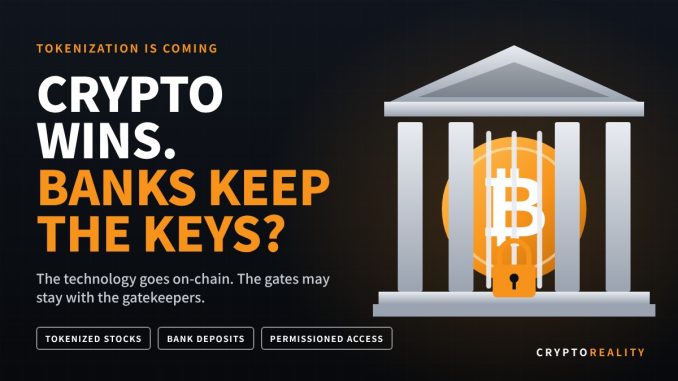
Wall Street, banks and regulators are moving finance on-chain. But the system they are building may keep the same gatekeepers in control.
For years, one of crypto’s biggest promises was simple: remove the middlemen. You would not need a bank to move money, and you would not need the traditional financial system to hold or transfer an asset. Blockchain was supposed to let people own and move value more directly.
But that future is starting to look very different.
The banks are not disappearing. Stock exchanges are not disappearing either. Instead, some of the biggest institutions in traditional finance are now adopting the same technology that was supposed to challenge them.
The New York Stock Exchange is building infrastructure for tokenized stocks. Major Canadian banks are working on tokenized bank deposits. The European Central Bank has launched infrastructure for settling tokenized assets in central bank money. In the United States, regulators are creating rules that could allow more traditional securities to trade on public blockchains.
Crypto may be winning the technology battle. That does not necessarily mean decentralization is winning too.
Verified
On September 23, NYSE and Blockchain.com announced an agreement to explore giving Blockchain.com users access to tokenized U.S. stocks and ETFs through NYSE’s planned digital trading platform. The system is not live yet and still depends on regulatory approval, but the direction is clear. NYSE wants to bring traditional securities closer to crypto-native investors and potentially allow trading outside normal market hours.
This is not NYSE’s first move in that direction. In March, NYSE announced a partnership with Securitize, which is helping build the infrastructure needed for tokenized securities. Securitize can act as a digital transfer agent and is also involved in connecting investors to NYSE’s planned digital trading system.
NYSE’s owner, Intercontinental Exchange, has gone further. In August, ICE agreed to invest in tZERO and license parts of tZERO’s blockchain patent portfolio. tZERO is also helping ICE work on digital transfer agents, tokenization and broker-dealer infrastructure.
What this shows is simple. NYSE is not waiting to see whether blockchain replaces traditional stock markets. It is building its own position inside the system that may come next.
The SEC is moving in the same direction. On September 17, it introduced a temporary five-year framework that would allow certain tokenized U.S. stocks to trade through new Tokenized Securities Venues.
One detail in those rules is especially important. The smart contracts must be public and run on a public, permissionless blockchain. But access to the actual trading system can still be permissioned, meaning the venue decides who is allowed to participate.
In simple terms, the technology can be open while the doors into the market are still controlled.
The SEC also requires tokenized stocks to give holders the same economic rights as the regular shares they represent. Companies can object if an outside party wants to tokenize their stock, and if trading in the normal stock is stopped, trading in the tokenized version must also stop.
So even if a stock moves onto a blockchain, it does not suddenly become an independent crypto asset. It remains connected to the company, the exchange and the regulated system behind it.
Something similar is happening with money.
On September 22, six of Canada’s largest banks — BMO, CIBC, National Bank, RBC, Scotiabank and TD — announced that they are jointly exploring tokenized Canadian-dollar bank deposits. Their first goal is to make those deposits easier to move between financial institutions, with a longer-term plan to connect them to other digital-asset systems.
A tokenized bank deposit may look more like crypto on the surface, but it is still bank money. The customer still has a relationship with the bank, and the bank remains part of the system.
The technology changes. The role of the bank does not necessarily disappear.
Europe is moving in the same direction. On September 21, the Eurosystem launched Pontes, which allows wholesale transactions involving tokenized assets to settle in central bank money. The ECB also said it is preparing to invest a small part of its own funds in tokenized securities so it can gain practical experience with the technology.
The wider picture is becoming easier to see. Tokenized assets are starting to connect with central bank money, regulated markets and existing financial infrastructure. The old financial system and the blockchain world are no longer developing separately.
DTCC is another important example. It sits at the heart of traditional U.S. market infrastructure, yet it is also moving deeper into tokenization. On September 16, Ondo Finance became the first tokenization company to join DTCC’s Fund/SERV network, which handles a large share of U.S. mutual fund activity.
Regulators are also openly preparing for this market to grow. On September 22, CFTC Chairman Michael Selig said markets need to prepare for what he called “mass tokenization,” on-chain finance and 24/7 markets. He argued that tokenization could become part of a more efficient financial system, while also saying that not every market should automatically move to continuous trading.
None of these events alone proves that the financial system is moving entirely onto blockchain. But taken together, they show something important: the biggest institutions in finance are no longer treating tokenization as a side experiment.
Our conclusion
The old idea of traditional finance versus crypto is becoming harder to defend.
NYSE does not need to turn into a normal crypto exchange. It can take the parts of blockchain it finds useful — faster settlement, tokenized ownership and longer trading hours — and connect them to a regulated NYSE market.
Banks can do the same thing with money. They do not need their customers to move into Bitcoin or decentralized stablecoins. They can turn normal bank deposits into digital tokens while keeping the banking relationship, the rules and the control around those deposits in place.
Central banks can connect their own settlement money to tokenized markets. Clearing systems can connect tokenized funds to the same infrastructure already used by traditional finance.
That means blockchain can become much more important without banks, exchanges or clearing systems becoming less important.
That is the part we think deserves more attention.
Our theory
The largest financial institutions may have realized that they do not need to defeat crypto. They can simply adopt the parts of the technology that are useful to them.
Blockchain can make markets faster. Tokenization can make assets easier to move. Smart contracts can automate parts of settlement and ownership. Markets may stay open longer, and investors may eventually be able to move between cash, stocks, bonds and other assets more easily than they can today.
But moving an asset onto a blockchain does not automatically remove control.
Someone still decides which assets can be issued. Someone still checks who is allowed into a regulated market. Someone still handles identity, compliance, custody, settlement and access to ordinary money.
Those control points may turn out to matter more than the blockchain itself.
The SEC’s new model is a good example. The blockchain underneath can be permissionless, while the market built on top can still decide who gets in.
That is a very different future from the early crypto idea of removing financial gatekeepers.
Instead, we may be watching those gatekeepers rebuild themselves on new technology.
Speculation
Citi recently estimated that tokenized assets could reach about $5.5 trillion by 2030 in its base-case scenario. That is only a forecast, not a guarantee, but the direction is worth watching because major institutions such as NYSE, DTCC and Nasdaq are already moving tokenization closer to their core businesses.
If this continues, the next phase of crypto may look very different from the last one.
A person could eventually open an app late at night, buy a tokenized stock, pay using digital dollars and have the trade settle through blockchain infrastructure almost instantly. To the user, that may feel like crypto.
But behind the screen there could still be a stock exchange, a broker, a regulated transfer agent, a bank, a custody provider and perhaps even central bank money.
We may still get tokenized assets, faster settlement and markets that never close. But the banks, exchanges and other gatekeepers may still be sitting in the middle of it all.
That leaves us with a different question from the one crypto started with.
Maybe the real battle was never about whether blockchain would win.
Maybe it was about who would control what gets built on top of it.
CryptoReality publishes independent analysis for information only. Nothing on this site is investment advice. Crypto assets are highly volatile and you can lose all of the money you invest.