Say a friend in Thailand owes you nothing, you owe them $5,000, and you both use USDT. You send it from your wallet to their account at a licensed Thai crypto exchange. The money is clean, the amount is small, and the exchange is regulated.
Under rules Thailand is now proposing, the exchange would have to turn that deposit away.
Not because $5,000 is too much. Because the wallet it came from isn’t your friend’s.
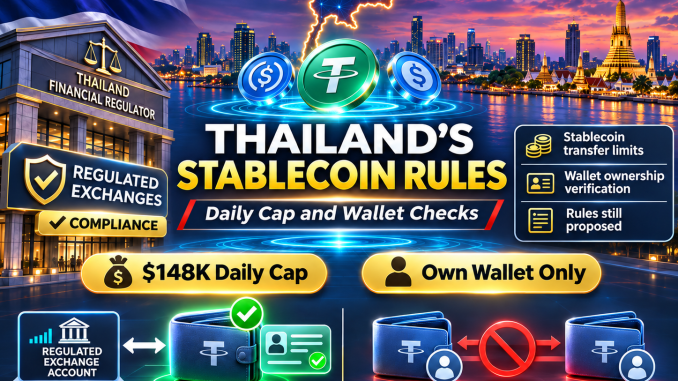
On 12 November 2026, Thailand’s Securities and Exchange Commission (SEC) published draft rules for stablecoin transfers through licensed digital asset businesses. The headline number is a daily cap of 5 million baht, about $148,000. But for ordinary users, the rule about who owns the wallet is the one that changes how crypto actually gets used.
The SEC says the goal is to fight money laundering, cybercrime and attempts to get around international money transfer rules.
The 5 million baht limit is only part of it
Under the draft, each customer could move up to 5 million baht worth of stablecoins into their account at a licensed operator per day. A separate 5 million baht limit would apply to withdrawals. (The dollar figure moves with the exchange rate. When the same idea was floated in September, it was reported as roughly $151,000.)
A few details matter here:
- The limit is per customer, per operator. It’s not one national cap across all of Thailand’s crypto market.
- Staying under the cap isn’t enough. The amounts would also have to make sense given the customer’s income and financial situation.
- There are exemptions. Moving stablecoins between your own accounts at two SEC-supervised platforms would not count toward the cap, as long as both comply with the Travel Rule. Operators’ own business transfers, approved stablecoin market makers and certain regulated token offerings and refunds would also be exempt.
Most importantly, these rules cover stablecoins moving through licensed platforms. They are not a limit on every stablecoin transaction on a blockchain.
Your wallet would have to be yours
This is the part that matters most.
Licensed operators would have to verify that the wallets and accounts on both sides of a stablecoin deposit or withdrawal belong to the customer. Deposits from someone else’s wallet would be banned. So would withdrawals to someone else’s wallet.
In practice:
- Allowed: you move USDT from your own self-custody wallet to your own account at a Thai exchange, once the exchange has confirmed both are yours.
- Not allowed: a friend, client or family member sends USDT straight into your exchange account, even if they can show exactly where the money came from.
- Not allowed: you withdraw USDT from your exchange account directly to someone else’s wallet.
Thailand is not banning payments between two people. Wallet-to-wallet transfers that never touch a licensed platform aren’t covered by this proposal. But anyone who uses a regulated exchange to receive payments or send money to others would have to change how they do it.
Why Thailand wants tighter controls
The SEC has been watching stablecoins for months. In September it reported a sharp rise in the number and value of stablecoin transactions through licensed operators, most of it in USDT. It also flagged patterns linked to money laundering, cybercrime and moving money abroad outside the normal rules.
Stablecoins can cross borders without passing through the banking system that handles traditional international payments. That’s exactly why they’re useful. It’s also why it can be hard to see who is really sending and receiving when money is routed through chains of accounts and wallets.
Thailand’s answer is to put the burden on the businesses that connect crypto users to the regulated financial system. Under the draft, they would have to:
- verify wallet ownership,
- screen customers and transactions,
- use blockchain analytics tools to spot links to suspicious wallets,
- follow the Travel Rule, which requires information about the sender and receiver to be collected and passed along with the transfer.
Whether this will stop criminals without getting in the way of ordinary users is the open question.
Exchanges and brokers would face new rules too
The draft goes further than deposits and withdrawals.
Exchanges would have to publish the names of their market makers, the firms that keep trading going by constantly placing buy and sell orders, along with the tokens each one provides liquidity for. They would also have to check where those firms’ assets come from.
Brokers would be banned from using liquidity providers for stablecoin-to-baht trading pairs. For certain trades arranged off the exchange, brokers and dealers would face a minimum size of 3 million baht and have to publish prices.
The measures are separate, but they all point the same way. Thailand wants to see where the money comes from, who controls it and how trades are carried out.
A safer market, but at what cost?
Scams, stolen funds and money laundering are real problems, and exchanges holding customer money need ways to catch them. But stricter checks bring practical questions the SEC hasn’t fully answered yet:
- How easy will it be to prove that an external wallet is yours?
- What happens when someone receives a legitimate payment from another person and wants to cash it out on an exchange?
- Will small businesses that accept stablecoins have to rethink how they get paid?
- How fast can exchanges tell suspicious activity apart from ordinary transfers without holding everything up?
The real impact will depend on the final wording and on how each exchange puts it into practice.
These rules are not in force yet
Thailand hasn’t banned stablecoins, and none of this is binding yet. This is the second round. The SEC consulted on the basic principles in September and says it took that feedback into account when writing this draft.
Public comments are open until 26 November 2026. No start date has been set, and the consultation proposes a 60-day transition period once the rules are final. The final version may look different.
Thailand is also experimenting on the other side of the system. This week its central bank was one of three that tested cross-border currency settlement between traditional and tokenized systems in [Project Meridian FX APAC](INTERN LÄNK: din Meridian-artikel).
The CryptoReality take
The $148,000 cap grabs the headlines, but it’s not the part most people will notice. Very few users move 5 million baht a day. Many more receive crypto from someone else, or send it to someone else, through an exchange.
That’s the real lesson here. Stablecoins move freely between private wallets. The moment they enter a regulated platform, the government decides how they can move, who can receive them and what has to be recorded along the way. Thailand isn’t trying to stop stablecoin transfers. It’s tightening control at the points where crypto meets the licensed financial system.
That could mean better protection against crime. It could also mean less flexibility for honest users. Neither should be assumed until the final rules are in place and their effects can be measured.
The question goes well beyond Thailand: if you can send stablecoins freely between private wallets but can’t move them through an exchange without proving who owns both ends, how much of the original freedom is left?
Want to understand what you’re really getting into before you buy crypto? [Get the book →]
FAQ
A cap of 5 million baht (about $148,000) per customer, per day, at each licensed digital asset operator. Deposits and withdrawals have separate limits.
Not under the draft. Licensed operators would only accept deposits from, and allow withdrawals to, wallets verified as belonging to the customer.
No. The proposal only covers transfers through licensed platforms, and it isn’t in force yet.
No date has been set. Public comments close on 26 November 2026, and the draft proposes a 60-day transition period after the final rules are published.
Sources
- Thailand SEC: draft regulation announcement, 12 November 2026
- Thailand SEC: earlier proposal, 3 September 2026
- The Block: Thailand seeks $148,000 daily cap on certain stablecoin transfers, 13 November 2026
CryptoReality publishes independent analysis for information only. Nothing on this site is investment advice. Crypto assets are highly volatile and you can lose all of the money you invest.