OKX and the owner of the New York Stock Exchange have launched round-the-clock trading of tokenized US stocks. Almost every big company they wanted to list refused to take part.
A new kind of stock market opened in the United States on 23 November. It’s called OKXICE, and it’s a joint venture between the crypto exchange OKX and Intercontinental Exchange (ICE), which owns the New York Stock Exchange. The pitch is that you can trade tokenized versions of US stocks at any hour, any day of the week, including Sunday night.
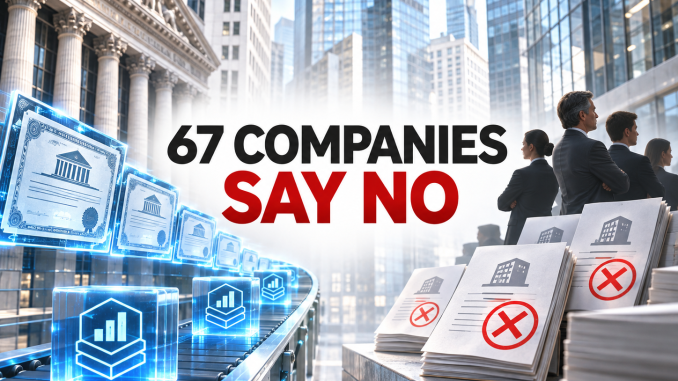
What you can’t do is trade Apple. Or Microsoft, Amazon, Alphabet, Nvidia, Tesla, Meta, JPMorgan Chase, Goldman Sachs, Walmart or Netflix. By the time the platform opened, 67 companies had formally told it to keep their shares off the list. All seven of the so-called Magnificent Seven were among them.
That’s a remarkable start for something billed as the future of the stock market, and it says a lot about where tokenization actually stands.
How the platform works
Each token on OKXICE is backed by a real share held in the background. According to the venue, holders get the rights that come with the share, including dividends and the right to vote.
Trading runs through automated liquidity pools built on Uniswap v4, on X Layer, OKX’s own Ethereum layer-2 network, rather than through a traditional order book. Securitize handles the tokenization itself. Customers keep the tokens in their own self-custodial wallets, and OKXICE never holds their assets or their private keys.
It’s still far from an open crypto market. Only eligible US customers who have passed identity verification can use it. The plumbing comes from DeFi, but the front door is very much locked.
Who is actually on it
Before launch, OKXICE said it expected to list more than 70 assets. Most of those are 59 ETFs from Direxion. The individual companies are Better.com, BitGo, Circle, Coinbase, Robinhood, Securitize and Strategy, almost all of them crypto or fintech firms that were never going to say no to an on-chain listing.
Why the big names could refuse
On 17 September, the US Securities and Exchange Commission (SEC) issued what it calls the Innovation Exemption. For five years, until September 2031, it lets qualifying platforms trade tokenized stocks without registering as a full stock exchange, while the regulator works out permanent rules.
The SEC added a safeguard for companies. If a platform wants to trade a tokenized version of a company’s stock without that company’s involvement, it has to notify the company first. The company then has 30 days to object, and if it does, that stock is off the table on that venue.
Companies used that right far more than OKXICE can have hoped. The first objections came in mid-October, and the list kept growing week after week. By 5 November it had reached 67. Of the companies OKXICE originally picked for its platform, almost 90% said no.
A no to this platform, not to the idea
It would be easy to read this as big business rejecting blockchain, but the objection right is much narrower than that. It applies to one venue at a time, and only to shares tokenized by an outside party. Apple objecting to OKXICE doesn’t stop Apple from tokenizing its own shares on its own terms some day.
What these companies turned down was someone else creating a new market for their stock that they had no say over.
They aren’t alone in thinking that way. SIFMA, the main trade association for US banks and brokers, says it supports the SEC’s experiment, but it wants third-party tokenized stocks to trade only when the company has actively agreed. Under that rule, a company that simply didn’t answer the letter wouldn’t count as a yes. Wall Street, in other words, hasn’t settled this among itself either.
What to think about before you trade
The idea of buying a stock at midnight on a Sunday is appealing. A few things are worth knowing first.
The token’s price won’t necessarily match the real share’s, especially when the regular market is closed. With thin weekend liquidity, prices can drift, and nobody knows yet how smoothly they snap back when trading opens on Monday morning.
OKXICE itself says it isn’t a registered stock exchange or broker-dealer and that the SEC hasn’t approved it. It runs under a temporary exemption with its own conditions, which is not the same as the full rulebook a traditional exchange has to follow.
Self-custody cuts both ways. Nobody can freeze your tokens, but nobody can get them back for you if you lose your keys either. And the smart contracts underneath are new code. Traditional markets have decades of experience handling outages and errors, while this one has a few days.
None of that makes OKXICE a bad idea. It does make it a very young one.
The CryptoReality take
We shouldn’t downplay what has happened here. A major crypto exchange and the company that owns the NYSE are running blockchain trading of real US securities, inside an SEC framework. A year ago that was a conference panel topic.
Still, the figure we’d remember from launch day is 67, not 70-plus.
Crypto has spent years selling a simple story, where you put an asset on a blockchain and the market around it becomes open, fast and always on. OKXICE shows the part that story usually skips. Representing a share as a token turned out to be the easy bit. Getting the companies behind those shares, the regulators and the rest of Wall Street to agree on how it should work is proving much harder, and no smart contract can do that part.
Over the next few months we’ll be watching three things. Does any large company change its mind? Do tokenized prices stay close to the real ones outside market hours? And do enough people actually trade here to make it a real market? Those answers will say far more than the launch-day headlines did.
FAQ
A joint venture between crypto exchange OKX and Intercontinental Exchange, owner of the New York Stock Exchange. It lets eligible US customers trade tokenized stocks and ETFs around the clock.
The SEC’s Innovation Exemption lets companies block outside platforms from trading tokenized versions of their shares. Most haven’t explained their reasons publicly, but the wider debate has centered on pricing, liquidity and investor protection.
No. Apple, Tesla and the rest of the Magnificent Seven all objected, so their shares can’t trade there under the exemption.
No. It operates under a temporary SEC exemption, and OKXICE says it is not a registered exchange or broker-dealer and has not been approved by the SEC
Sources
- OKX: Digital Securities are Coming to OKXICE TSV
- SEC: Innovation Exemption (17 September 2026)
- Troutman Pepper: SEC Innovation Exemption, subject to issuer objection
- SIFMA: The SEC’s Innovation Exemption
- Decrypt: OKX-ICE tokenized stock venue sets launch as Big Tech opts out
- CryptoSlate: Apple, Nvidia and 65 other companies object to OKXICE
CryptoReality publishes independent analysis for information only. Nothing on this site is investment advice. Crypto assets are highly volatile and you can lose all of the money you invest.