
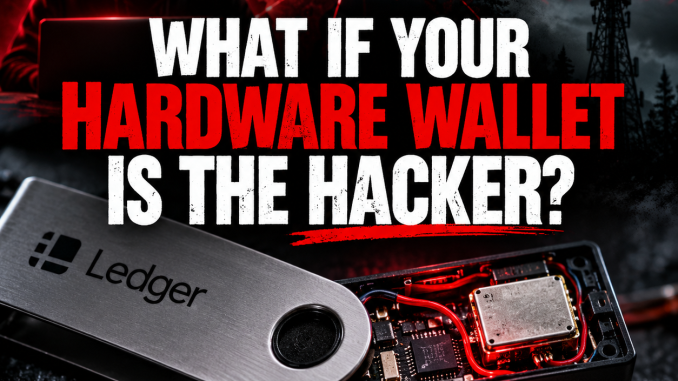
Hardware wallets are supposed to remove trust from crypto. But Ledger has confirmed that some devices sold through a reseller contained hidden hardware capable of stealing a user’s recovery phrase and sending it away over a mobile network. The attack raises a much bigger question: how much trust have we really removed?
For years, crypto users have been told the same thing.
Keep your coins off exchanges. Control your own keys. Buy a hardware wallet. Never share your recovery phrase.
For some Ledger customers, that was not enough.
Ledger has confirmed that hardware wallets sold through Southeast Asian reseller CryptoBilis contained an unauthorized physical implant. The hidden hardware was capable of reading the 24-word recovery phrase when it appeared on the device’s screen during setup. It could then transmit those words to an attacker using LTE and an eSIM.
This was not someone guessing a password.
It was not malware installed on the user’s computer.
And it was not a fake website asking someone to type in their recovery phrase.
The device itself had been physically changed.
The wallet could see the secret
A recovery phrase is one of the most important pieces of information a crypto owner has.
Anyone who obtains those words can recreate the wallet somewhere else and move the funds. They do not need to steal the physical Ledger device.
According to Ledger’s investigation, the added hardware could recognize the recovery words shown on the device’s display during setup. The implant then transmitted that information through a mobile connection.
What makes the attack particularly interesting is what apparently was not changed.
Ledger says the implant did not modify the Secure Element that protects private keys. It did not change Ledger’s operating system. It did not alter transactions or signatures.
That means the normal security system could continue working while another piece of hardware quietly watched the screen.
The wallet could look normal.
It could behave normally.
And the user could still lose the one secret that protects everything.
This appears to be a supply-chain attack
Ledger says the confirmed losses it has investigated were connected to devices sold by CryptoBilis. The company says it has found no indication that Ledger’s own infrastructure, systems or services were compromised.
CryptoBilis has stopped selling Ledger devices while the investigation continues.
But the story has already moved beyond one small reseller.
MediaMarktSaturn stopped selling Ledger devices after a customer in Germany reported finding an implant inside a device. Ledger confirmed an unauthorized implant in the reported German device, although no loss of funds was reported in that case.
Ledger has not established that the German incident came from the same source as the CryptoBilis devices.
There have also been other claims involving allegedly modified Ledger devices. Those reports should be treated carefully while the investigation continues.
There is another number that needs the same caution.
Blockchain investigators have estimated that tens of millions of dollars may have been stolen from hundreds of wallets connected to the incident. Ledger has said it has not verified the total number of victims or the total amount lost.
So we are not going to present those estimates as confirmed losses.
Verified
What is confirmed is already serious enough.
Physical implants were found inside Ledger devices connected to CryptoBilis. The implants were designed to capture recovery phrases and transmit them through a cellular connection.
This changes the security problem.
The owner did not necessarily have to make the usual mistake of entering a seed phrase into a website or sharing it with another person.
The attack happened earlier in the chain.
Someone had access to the hardware before the customer did.
Our conclusion
Crypto often talks about removing trust.
That is one of the strongest arguments for self-custody. You no longer need to trust an exchange to hold your Bitcoin or other crypto.
But self-custody does not remove every form of trust.
You still trust the company that designed your wallet.
You trust the factory that produced it.
You trust the people who handled it.
You may trust a distributor, a reseller and a store before the box ever reaches your hands.
Most of the time we never think about that chain because the device arrives sealed, looks normal and passes the checks we expect it to pass.
This attack shows why that assumption matters.
Ledger’s security checks could verify the genuine parts of the device while unauthorized hardware had been added around them. The Defiant reported that Ledger’s Genuine Check cannot rule out this type of physical modification.
That does not mean hardware wallets are useless.
It means the security model is more complicated than the slogan.
Our theory
The biggest consequence may not be the amount of crypto stolen.
It may be what hardware-wallet companies do next.
If a criminal can attack a hardware wallet somewhere between production and the customer’s hands, manufacturers will have to protect more than software and private keys.
They will have to protect the entire path from factory to owner.
Ledger has already said it is reviewing reseller controls, anti-tamper protections and chain-of-custody practices. Other hardware-wallet companies have also begun reviewing their reseller networks following the incident.
That may eventually change how these devices are sold.
Buying a hardware wallet from an ordinary electronics store once sounded safer than ordering from an unknown website.
Now even that assumption deserves another look.
The uncomfortable part
There is an old rule in crypto:
Not your keys, not your coins.
It is still true.
But this incident adds another question.
What if someone gets your keys before you even realize they have them?
A hardware wallet protects you from many risks. It does not magically remove every person, company and supply chain between the factory and your hands.
Crypto was built around the idea that we should not have to trust intermediaries with our money.
The Ledger incident shows that even when we hold the keys ourselves, there can still be someone else we are trusting.
The question is no longer only who holds your keys.
It is also: who built the device that showed them to you?
CryptoReality publishes independent analysis for information only. Nothing on this site is investment advice. Crypto assets are highly volatile and you can lose all of the money you invest.