
A hardware wallet has one job: keep your recovery phrase away from everyone but you.
Now some of them have been doing the opposite.
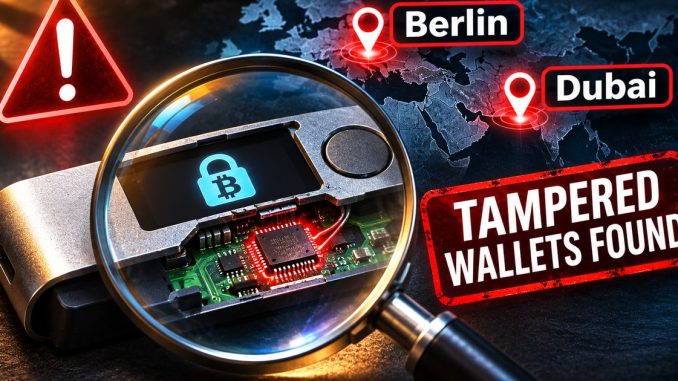
On 18 November, Ledger said it had found physically tampered wallets in Berlin and is investigating two more reports from Dubai. Every confirmed device has the same kind of modification: hidden components added inside a genuine Ledger, built to capture the recovery phrase while the owner sets the device up.
The problem started in Southeast Asia and has now reached Europe and the Middle East. It isn’t limited to Ledger either. Trezor has found the same kind of implant in its own devices.
If you own a hardware wallet, here’s what has happened and what to check.
What happened
In October 2026, Ledger disclosed an attack that had been running for months. According to the company, criminals bought real Ledger devices, opened them, fitted hidden components and put them back on sale through resellers in Southeast Asia. When buyers set up their wallets, the implant captured the recovery phrase. The attackers later emptied the wallets in one coordinated operation.
The reseller at the center of the case is CryptoBilis, which sold hardware wallets in Indonesia, Malaysia and the Philippines. Ledger asked its resellers across Southeast Asia and Hong Kong to stop selling its devices while it investigated.
Europe followed quickly. In October, a customer in Germany reported a suspected implant, and the MediaMarktSaturn chain paused Ledger sales in its stores and online. At the time, Ledger said the devices it bought from German stores and warehouses for testing were all clean.
That has now changed. Ledger has confirmed tampered devices in Berlin, and its advisory covers anyone who bought there from a third-party seller from January 2026 onward. Two reports from Dubai are still under investigation.
Ledger says the number of affected devices is small, but it expects to find more.
Is Ledger hacked?
No, based on what is known so far.
Ledger says there is no flaw in its secure chip, its operating system or its servers. The attack targeted the distribution chain, after the devices had left Ledger’s hands. The company also says there is no confirmed case involving a device bought directly from ledger.com.
That matters, but it’s cold comfort if you bought from someone else. Because these were real Ledger devices with extra parts added, a software check that the device is genuine may not reveal anything is wrong.
Trezor found the same thing
This isn’t a Ledger-only problem.
Trezor has confirmed implants in three Trezor Safe 5 devices sold by the same reseller, CryptoBilis, between 20 August and 23 September 2026. The implant is an extra circuit board fitted between the main board and the screen. It copies what the screen shows, including the recovery words, and sends it out over a mobile network.
On 11 November, Trezor released firmware version 2.13.1, which stops the implants it has found from capturing anything. It also cut its reseller network by about 80%. But Trezor is clear that the update can’t protect a recovery phrase that was already captured. If you bought from CryptoBilis, you should still move your funds.
So far, no Trezor customer has reported losing money.
What buyers need to check
1. Where did you buy it?
This is the most important question.
- Directly from Ledger or Trezor: no confirmed cases so far.
- From a third-party seller in Southeast Asia or Hong Kong, in Berlin (from January 2026), or in Dubai: contact the manufacturer’s support now.
- Any Trezor bought from CryptoBilis since March 2026: you can get a replacement or a refund.
- A marketplace, an auction site or a “great deal” from a stranger: treat it as unknown, wherever you are.
2. Did a recovery phrase come with the device?
If the box contained a pre-printed recovery phrase, or a card telling you to use one, it is a scam. A real wallet always generates a new phrase on the device when you set it up. Never use one someone else gave you.
3. Don’t trust the packaging.
Seals and shrink-wrap can be faked. An untouched-looking box tells you nothing about what’s inside.
4. Are you running the latest firmware?
Trezor Safe 5 owners should update to version 2.13.1. Keep any hardware wallet up to date through the manufacturer’s official app.
5. Has anyone asked for your recovery phrase?
Ledger Support will never ask for your 24 words. Neither will Trezor. Anyone who does, by email, phone or WhatsApp, is trying to rob you. Expect scammers to use this story as an excuse to contact worried owners. Here are the WhatsApp security settings every crypto holder should check.
If you think your device is affected
Ledger’s advice:
- Stop using the device. Don’t set up or restore a wallet with it.
- Contact Ledger Support through its official website. For a limited time, Ledger can inspect suspected devices, including with X-rays, at its factory in Vierzon, France.
- Move your funds to a new wallet with a brand-new recovery phrase, created on a device bought directly from the manufacturer.
- Never reuse the old recovery phrase or passphrase. Assume they are known to someone else.
- Report suspected tampering to the police.
Do this even if your balance looks fine. Attackers can sit on stolen recovery phrases and empty wallets later, all at once.
What changes now
Ledger has tightened the rules for its authorized resellers. Returned devices may never be resold, even if they look unopened. Ledger devices should no longer sit on shelves or displays, but stay in the stockroom until the moment of sale. Resellers must report any customer complaint about an unusual product straight to Ledger.
Trezor has made similar changes to how its remaining resellers source, store and handle devices.
The CryptoReality take
Here’s the uncomfortable lesson: a hardware wallet is only as trustworthy as the route it took to reach you.
The chip can be perfect and the software flawless. If someone opened the box before you did, none of that helps. The attackers didn’t break the technology. They went around it.
That doesn’t mean hardware wallets are useless. For most people holding meaningful amounts of crypto, they’re still the safest option. But how you buy one matters as much as which one you buy. Saving a few euros through a reseller, a marketplace or a “discounted” listing isn’t worth the risk.
Buy directly from the manufacturer. Set the device up yourself. Write down the recovery phrase it generates, and never let anyone else see it.
FAQ
Ledger says there is no flaw in its chip, software or servers, and no confirmed case involves a device bought directly from ledger.com. The risk comes from devices that were tampered with before they were sold.
In Southeast Asia, where the case started, and in Berlin. Ledger is also investigating two reports from Dubai.
Trezor has confirmed implants in three Trezor Safe 5 devices sold by the reseller CryptoBilis. It released firmware 2.13.1 on 11 November to block the implants it has found.
If you bought it in one of the affected areas, contact the manufacturer’s support, stop using the device and move your funds to a new wallet with a new recovery phrase.
Sources
- Bitcoin.com News: Ledger expands crypto wallet tampering probe to Berlin and Dubai (18 November 2026)
- Ledger: Our response to the hardware implant attack (15 October 2026)
- Trezor: Our CryptoBilis investigation, what we found and what we’ve changed
- The Block: Ledger confirms hardware implant in CryptoBilis reseller units (13 October 2026)
CryptoReality publishes independent analysis for information only. Nothing on this site is investment advice. Crypto assets are highly volatile and you can lose all of the money you invest.


