
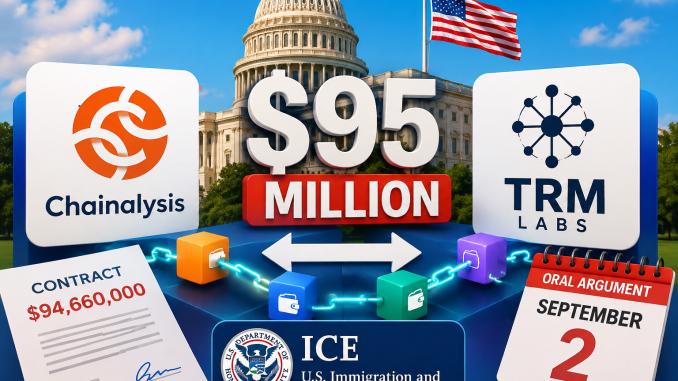
One of the largest U.S. government blockchain-analysis contracts has turned into a federal court fight. Chainalysis says ICE designed the procurement around capabilities TRM Labs already had. The case raises a much bigger question about who controls the data governments use to identify people on public blockchains.
Crypto privacy is usually discussed as a fight between users, exchanges and blockchains.
But behind that debate sits another industry that most people rarely see.
Companies such as Chainalysis and TRM Labs build the tools governments use to trace crypto transactions, identify wallets, investigate scams and connect blockchain activity to real-world people and organizations.
One of the largest government contracts in that industry has now become the subject of a federal court fight.
U.S. Immigration and Customs Enforcement, better known as ICE, awarded TRM Labs a contract worth approximately $94.66 million for blockchain forensic software and related support.
The contract was awarded on a sole-source basis, meaning ICE did not conduct a normal full competitive procurement.
Now Chainalysis Government Solutions, one of TRM’s largest competitors, is challenging the award.
Its accusation is serious:
ICE may have structured the requirements around capabilities TRM already possessed while giving competitors very little opportunity to prove they could do the work.
That is an allegation, not an established fact.
No court has ruled that ICE or TRM Labs acted improperly.
But when almost $95 million in taxpayer money and some of the U.S. government’s most powerful crypto-tracing infrastructure are involved, the details matter.
The contract is worth almost $95 million
The ICE contract covers forensic software and support for Homeland Security Task Force investigations.
According to reporting based on federal procurement records, the contract runs from July 1, 2026 through June 30, 2027 and has a value of about $94.66 million.
The work may involve areas such as crypto tracing, scam investigations, cybercrime, asset recovery, AI-assisted analysis and coordination around illicit digital assets.
But the most important part of the dispute is not the size of the contract.
It is how ICE awarded it.
The agency determined that TRM Labs was the vendor capable of meeting its requirements and moved ahead with a sole-source award.
That is not automatically improper.
Government agencies can use sole-source procurement when they conclude that only one provider can meet a specialized need.
The dispute is over whether ICE reached that conclusion fairly.
Chainalysis says the requirements looked unusually specific
Chainalysis Government Solutions filed its case in the U.S. Court of Federal Claims on July 27, 2026.
TRM Labs later entered the case to defend the award alongside the government.
A redacted version of Chainalysis’ complaint provides more detail about what the company says happened.
According to the complaint, ICE’s Request for Information included questions about capabilities such as:
- a large proprietary database of scam victims,
- AI-powered investigative tools,
- automated notifications to crypto service providers,
- relationships with stablecoin issuers,
- systems for coordinating asset freezes.
Chainalysis argues that several of those capabilities closely resembled features already associated with TRM Labs.
That alone does not prove favoritism.
Government agencies often write requirements around very specific operational needs.
But the next part of the complaint is harder to ignore.
Competitors allegedly got three days and one page
After ICE signaled its intention to award the contract to TRM, other companies were given a chance to show that they could meet the agency’s requirements.
According to Chainalysis, they were given about:
three days
and
one page
to make their case.
Chainalysis says it was the only company that responded.
It also alleges that ICE rejected its submission without asking follow-up questions about its technology, law-enforcement work or existing government experience.
The company’s argument is straightforward.
If certain capabilities were truly mandatory, every potential bidder should have known that clearly from the beginning.
And if those capabilities were not mandatory, they should not later have been used as the reason only TRM qualified.
That is the heart of the procurement dispute.
The government and TRM dispute Chainalysis’ position, and the court has not yet ruled on who is right.
This is bigger than two companies fighting over a contract
At first glance, the case looks like a normal business dispute.
Chainalysis lost a huge contract.
TRM won it.
Chainalysis sued.
But blockchain-analysis companies are not ordinary software vendors.
They provide much of the private infrastructure behind public crypto enforcement.
Governments do not build every tracing system themselves.
They buy access to technology, datasets and investigative tools from private companies.
Those companies may hold enormous databases containing information about:
- wallets,
- transactions,
- scam reports,
- exchange activity,
- entity attribution,
- links between blockchain addresses and real-world organizations,
- relationships with financial institutions and crypto businesses.
That makes them unusually powerful.
A blockchain may be public.
But the database that tells investigators who may be behind a wallet is usually not.
That distinction matters.
The most valuable asset may not be the software
The obvious assumption is that ICE is paying almost $95 million for blockchain-analysis software.
But the real competitive advantage may be harder to copy than code.
Look at the capabilities emphasized in the dispute:
victim data, exchange coordination, stablecoin relationships, automated alerts, wallet intelligence and law-enforcement workflows.
Those things depend on more than software engineering.
They depend on data, integrations, institutional relationships and trust.
That creates a powerful feedback loop.
A company with more data can build a better product.
A better product can win more government customers.
More government customers create more integrations and relationships.
Those integrations produce even more data and experience.
Over time, the vendor becomes increasingly difficult to replace.
That is where specialization can start turning into vendor lock-in.
Chainalysis has also benefited from sole-source contracts
There is an important detail that keeps this story from becoming too simple.
Chainalysis itself has previously received U.S. government blockchain-analysis work through sole-source arrangements.
Reporting on the current case notes prior ICE purchases involving Chainalysis technology.
That matters because this is not simply a story about one company opposing a procurement method it has never benefited from.
It is a battle between two large companies operating inside an industry where agencies may argue that only a small number of vendors have the data, expertise and integrations required for certain investigations.
That creates a broader problem.
At what point does specialized expertise become an obstacle to real competition?
Crypto surveillance could become highly concentrated
Crypto was built around the idea of decentralization.
Some of the infrastructure used to monitor it may move in the opposite direction.
Imagine that only a handful of private companies eventually control the most advanced systems for:
- identifying wallets,
- mapping transaction networks,
- flagging illicit funds,
- coordinating asset freezes,
- connecting blockchain activity to real people.
Those companies would not control Bitcoin or Ethereum.
They would not control the blockchain itself.
But they could control a large part of the interpretation layer sitting above it.
That may turn out to be just as important.
The raw transaction is public.
The answer to the question “Who is this wallet?” may sit inside a private proprietary database.
That gives blockchain-analysis firms a kind of power that is easy to underestimate.
The next crypto battle may be over data
There is currently no public evidence proving that ICE deliberately manipulated the procurement process to benefit TRM Labs.
Chainalysis is alleging an unfair process.
TRM and the government are defending the award.
The court will decide whether ICE complied with procurement law.
But even if ICE wins the case, a bigger issue remains.
Crypto’s first major power struggle was about:
Who controls the money?
Then came:
Who controls the exchanges?
Now another question is becoming more important:
Who controls the data that tells governments who owns the money?
That matters because public blockchains do not automatically reveal identity.
They reveal addresses, transactions and flows.
The connection between those addresses and real people often comes from proprietary datasets, exchange information, investigative work and private analytics.
Whoever controls that layer may become one of the most important players in crypto enforcement.
The real question
A nearly $95 million government blockchain-surveillance contract has now put two of the biggest names in crypto analytics on opposite sides of a federal lawsuit.
The court will decide whether ICE’s procurement process was lawful.
But there is another question the court cannot answer for us:
How much power should a small number of private companies have over the infrastructure governments use to identify and trace people on public blockchains?
That is the part of this story worth following.
Because the future of crypto surveillance may depend less on who controls the blockchain than on who controls the information that explains it.
Sources
The Block — Chainalysis challenge to ICE’s TRM Labs contract
https://www.theblock.co/news/business/2026-08-30-chainalysis-accuses-ice-of-unfairly-steering-95-million-blockchain-contract-to-trm-labs-413066
Decrypt — Chainalysis lawsuit and TRM intervention
https://decrypt.co/375843/chainalysis-sues-us-government-ice-contract-trm-labs
CryptoReality publishes independent analysis for information only. Nothing on this site is investment advice. Crypto assets are highly volatile and you can lose all of the money you invest.


