
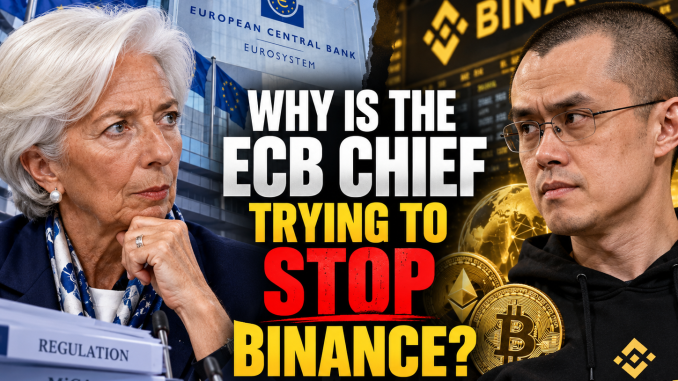
The ECB does not issue crypto licenses. Yet Christine Lagarde reportedly intervened as Binance moved closer to EU approval. So what was she worried about — Binance, the dollar, or the digital euro?
Binance thought it was getting close.
The world’s largest crypto exchange had applied for a MiCA license in Greece. If approved, that license could have opened the door for Binance to operate across the European Union under one regulatory framework.
According to reporting by The Wall Street Journal, the process had moved far enough that Binance was preparing for approval. CEO Richard Teng was reportedly planning a trip to Athens, and the company had even prepared an announcement.
Then something changed.
And the person reportedly pushing against Binance was not the Greek regulator.
It was European Central Bank President Christine Lagarde.
The strange part: the ECB does not issue the license
Under MiCA, crypto exchange licenses are handled by national regulators. In this case, that was Greece’s Hellenic Capital Market Commission.
The ECB does not decide whether Binance gets that license.
Yet according to the Journal, Lagarde personally urged Greek Prime Minister Kyriakos Mitsotakis not to approve Binance’s application.
A senior Greek regulator reportedly later told Binance about Lagarde’s intervention. The Journal also reported that European securities regulator ESMA had separately raised concerns about Binance’s compliance history.
That creates an obvious question.
Why was the head of Europe’s central bank getting involved?
There are two possible answers. And the second one may be much more important than Binance itself.
The first explanation is simple: Binance has baggage
There are legitimate reasons for European regulators to examine Binance very carefully.
In 2023, Binance pleaded guilty in the United States to violations involving anti-money-laundering and sanctions rules and agreed to pay more than $4 billion to resolve the case. Founder Changpeng Zhao stepped down as CEO as part of the settlement.
For regulators responsible for protecting Europe’s financial system, that history matters.
If Lagarde’s concern was simply that one of the world’s largest crypto exchanges required deeper scrutiny before receiving access to the entire EU market, there is nothing mysterious about that.
But that is not the only concern being reported.
Then we get to the dollar
The Journal reports that Lagarde was also concerned about something much bigger:
dollar-based stablecoins.
This changes the story.
Stablecoins such as USDT and USDC allow people around the world to hold and move digital dollars without using a traditional dollar bank account.
For Europe, that creates a very different problem from Bitcoin.
Bitcoin competes with currencies in an abstract way. Dollar stablecoins put something much more familiar directly into people’s wallets:
the U.S. dollar.
And Binance gives those digital dollars access to an enormous global user base.
So perhaps the question is not simply whether Europe trusts Binance.
Perhaps the bigger question is whether Europe wants millions more Europeans using digital dollars.
The digital euro changes everything
The ECB is simultaneously developing the digital euro.
That means Europe is trying to build its own digital form of central-bank money while private companies are already distributing digital dollars globally through stablecoins.
Those two developments are not happening in isolation.
If dollar stablecoins become the normal way Europeans store money, trade digital assets and make blockchain payments, the ECB could eventually face a much larger problem than crypto speculation.
It could face digital dollarization.
That does not mean Lagarde tried to stop Binance because she wanted to protect the digital euro. The public evidence does not establish that motive.
But the reported stablecoin concern makes the question legitimate.
And it creates an uncomfortable conflict.
What exactly was Europe protecting?
Imagine the situation from the ECB’s perspective.
Binance receives a MiCA license.
That license gives the world’s largest crypto exchange a regulated path deeper into Europe.
Binance brings enormous liquidity.
Stablecoins remain central to crypto trading.
And most of the world’s major stablecoins are tied not to the euro, but to the dollar.
Suddenly this is no longer just a discussion about regulating a crypto exchange.
It becomes a discussion about which currency dominates Europe’s future digital financial system.
The euro?
Or tokenized dollars issued by private companies?
That is a very different battle.
Verified
Binance applied for MiCA authorization through Greece. Binance later withdrew that application on June 24 and said it would seek authorization in another EU member state. Binance itself said no formal decision had been issued before it withdrew.
The ECB does not itself grant MiCA licenses to crypto exchanges. National regulators handle those authorizations.
The Wall Street Journal reports, based on people familiar with the matter and documents it reviewed, that Lagarde intervened against Binance’s application and that concerns included Binance’s compliance record and dollar-denominated stablecoins.
Our conclusion
There is a perfectly reasonable regulatory case for examining Binance closely. Its previous compliance failures are real, documented and significant.
But that alone does not answer the most interesting question.
Why did the president of the European Central Bank reportedly become personally involved in a licensing process that the ECB does not control?
Once concerns about dollar stablecoins enter the discussion, the story becomes bigger than Binance.
It becomes a story about money.
Our theory
Europe may be facing a problem that crypto regulation alone cannot solve.
The next battle may not be crypto versus banks.
It may be digital dollar versus digital euro.
Stablecoins have already given the dollar something the euro does not yet have at comparable global scale: a widely used digital version that can move across blockchain networks around the clock.
Binance can accelerate that infrastructure because of its size, liquidity and users.
From that perspective, a MiCA license for Binance is not simply permission for another exchange to operate.
It could also strengthen the infrastructure through which digital dollars circulate inside Europe.
That does not prove this was Lagarde’s motivation.
But it would explain why the president of a central bank might care about a crypto-exchange license that technically belongs to somebody else’s regulator.
Speculation
There is an even bigger possibility worth watching.
Europe may increasingly regulate crypto not only around fraud, money laundering and consumer protection, but around monetary sovereignty.
If that happens, stablecoins become politically much more important.
USDT and USDC are no longer merely crypto products. At sufficient scale, they become privately operated global distribution networks for the U.S. dollar.
And the companies and exchanges distributing them become part of a geopolitical monetary competition.
That would explain why central banks are paying attention.
Not because Binance is just another crypto exchange.
But because the infrastructure being built around exchanges, stablecoins and blockchains could eventually influence which money people actually use.
And that brings us back to the question we started with:
Was Christine Lagarde trying to protect Europe from Binance — or protect the euro from what Binance could help spread?
For now, we don’t know.
But that is the question worth watching
CryptoReality publishes independent analysis for information only. Nothing on this site is investment advice. Crypto assets are highly volatile and you can lose all of the money you invest.