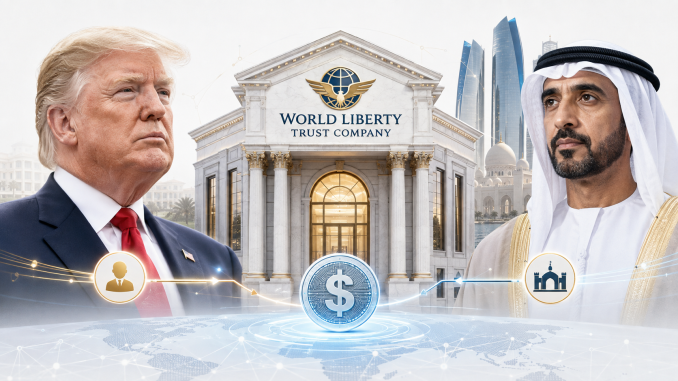
Four days before Donald Trump returned to the White House, investors backed by one of the UAE’s most powerful officials agreed to buy 49% of World Liberty Financial for $500 million. What followed was a remarkable sequence involving AI chips, a $2 billion Binance deal, World Liberty’s USD1 stablecoin, a presidential pardon and now a proposed federally regulated U.S. trust bank.
Four days before Donald Trump returned to the White House in January 2025, a remarkable deal was signed.
An investment group backed by Sheikh Tahnoon bin Zayed Al Nahyan, the United Arab Emirates’ national security adviser and brother of the country’s president, agreed to invest $500 million in World Liberty Financial, the crypto business associated with the Trump and Witkoff families.
The investment bought the group a 49% stake in the company.
That alone would have been significant.
But the story did not end there.
Over the following months, Tahnoon met Trump at the White House. The UAE committed to a huge U.S. investment framework. Washington moved toward giving the UAE far greater access to advanced American AI technology. Tahnoon-linked MGX used World Liberty’s new stablecoin in a $2 billion investment in Binance.
Later, President Trump pardoned Binance founder Changpeng Zhao.
Then World Liberty moved toward something much bigger than a crypto token.
It applied to create a federally chartered U.S. trust bank.
In August 2026, the Office of the Comptroller of the Currency gave that bank preliminary conditional approval.
And reporting from The Wall Street Journal subsequently revealed another important connection: Tahnoon-backed investors hold 49% of the holding company behind the proposed bank, while a Trump-family-affiliated entity holds about 38%.
None of that proves corruption.
There is no public evidence of a secret agreement exchanging private investment for U.S. government policy.
But once the money, ownership and government decisions are placed on the same timeline, a much harder question appears:
Where does foreign investment end, private business begin, and U.S. government policy enter the picture?
Start With the Man Behind the Money
Sheikh Tahnoon bin Zayed Al Nahyan is not simply a wealthy investor interested in crypto.
He is the national security adviser of the United Arab Emirates, the brother of UAE President Sheikh Mohamed bin Zayed and one of the most powerful financial figures in Abu Dhabi.
His sphere of influence includes major technology and investment interests such as G42 and MGX.
That matters because Tahnoon had another strategic interest involving the United States at roughly the same time:
advanced artificial-intelligence technology.
For years, Washington had worried that the most powerful American AI chips supplied to the UAE could eventually become accessible to Chinese companies.
G42 was particularly sensitive because of its previous relationships involving China.
Against that background, the World Liberty investment becomes much more interesting.
January 16, 2025: The $500 Million Deal
According to company documents reviewed by The Wall Street Journal, Aryam Investment 1, an entity backed by Tahnoon, agreed on January 16, 2025 to purchase 49% of World Liberty Financial for $500 million.
Donald Trump was inaugurated four days later.
Eric Trump signed the agreement on World Liberty’s side.
The Journal reported that approximately $187 million of the first $250 million installment went to Trump-family entities, while at least another $31 million was designated for Witkoff-related entities.
Later reporting indicated that Trump-family entities ultimately received approximately $263 million connected to the transaction.
This distinction is important.
We are not talking about someone buying WLFI tokens on an exchange.
We are talking about a major equity investment in the company itself.
The Tahnoon-backed group became World Liberty’s largest outside shareholder.
Two Months Later, Tahnoon Was at the White House
On March 18, 2025, President Trump hosted Sheikh Tahnoon at the White House.
The meeting itself is not secret. The White House published photographs of it.
Around the same period, the administration announced that the UAE had committed to a 10-year, $1.4 trillion U.S. investment framework.
According to the White House, that investment would target areas including artificial intelligence infrastructure, semiconductors, energy, quantum computing, biotechnology and manufacturing.
Taken separately, there is a straightforward strategic explanation.
The United States wants foreign capital.
The UAE wants greater access to American technology and deeper economic ties with Washington.
Neither objective is inherently suspicious.
But there was now another fact sitting beside them:
One of the UAE’s most powerful officials had just backed a $500 million investment for almost half of a company financially connected to the U.S. president’s family.
That is where the conflict-of-interest question begins.
Then Washington Opened the Door to More AI Chips
In May 2025, Reuters reported that the Trump administration was close to an agreement that could allow the UAE to import approximately 500,000 of Nvidia’s advanced AI chips per year.
Around 100,000 annually could go to G42, according to the proposal Reuters described.
The U.S. and UAE then announced a broader technology framework and AI partnership.
The administration’s argument was clear: closer cooperation could strengthen American AI leadership, attract enormous UAE investment into the United States and include safeguards intended to keep U.S. technology from being diverted to China.
That is a legitimate policy argument.
But look at the timeline.
January 16, 2025
Tahnoon-backed investors agree to buy 49% of World Liberty.
March 18
Tahnoon meets President Trump at the White House.
March 2025
The UAE commits to a $1.4 trillion U.S. investment framework.
May 2025
Washington moves toward allowing dramatically greater UAE access to advanced AI infrastructure and chips.
Timing alone does not prove causation.
There is no public contract, email, testimony or document showing that Tahnoon invested in World Liberty in exchange for AI technology.
We cannot claim that.
But the overlap became significant enough that members of Congress began asking the same question.
Then World Liberty Created USD1
World Liberty launched its dollar-backed stablecoin USD1 in 2025.
The basic idea is simple.
One USD1 is designed to remain worth approximately one U.S. dollar.
But the economics behind a large stablecoin can be extremely valuable.
When users exchange billions of dollars for stablecoins, the issuer can hold reserves in assets such as cash and short-term U.S. government securities.
Those reserves can earn interest.
At roughly $4 billion in circulation, the reserve pool becomes substantial. The Wall Street Journal estimated that assets backing USD1 could produce around $150 million a year in interest at prevailing rates, although that is an estimate rather than guaranteed revenue.
And then Abu Dhabi gave the young stablecoin an extraordinary early use case.
The $2 Billion Binance Deal
In 2025, Abu Dhabi-backed investment firm MGX made a $2 billion investment in Binance.
But the transaction was not simply completed with ordinary bank dollars.
World Liberty announced that MGX would use:
USD1.
Reuters confirmed the arrangement.
That mattered.
World Liberty had created a new stablecoin, and almost immediately a Tahnoon-linked institutional investor was using it in one of the largest crypto transactions of the year.
Reuters later reported that the Binance transaction represented a very large share of USD1’s circulation at the time.
Put the sequence together:
Tahnoon-backed capital
→ buys 49% of World Liberty
→ World Liberty creates USD1
→ Tahnoon-linked MGX uses USD1 in a $2 billion Binance investment
→ USD1 suddenly receives enormous institutional adoption and reserve assets.
These are not hidden transactions.
That is exactly why they are interesting.
Binance Adds Another Layer
The Binance connection later became even more politically sensitive.
Binance accepted USD1 in the $2 billion MGX transaction, helping give World Liberty’s stablecoin credibility and visibility.
Then, on October 23, 2025, President Trump pardoned Binance founder Changpeng “CZ” Zhao.
Zhao had previously pleaded guilty to violating U.S. anti-money-laundering requirements and had served a prison sentence.
The White House said the pardon was part of Trump’s effort to reverse what the administration considered excessive crypto enforcement under President Biden.
There is no public evidence proving that Binance’s relationship with USD1 was exchanged for Zhao’s pardon.
That needs to be stated clearly.
But once again, the sequence is unusual enough to examine:
Binance accepts USD1 in a $2 billion transaction
→ USD1 receives huge institutional exposure
→ World Liberty and Binance have a major commercial connection
→ months later the U.S. president pardons Binance’s founder.
That is not proof of an illegal bargain.
It is a conflict-of-interest question.
Those are not the same thing.
Then World Liberty Decided to Become a Bank
This may ultimately be the most important part of the story.
World Liberty is no longer simply building tokens and a stablecoin.
It applied to establish:
World Liberty Trust Company, National Association.
That would be a federally chartered national trust bank.
On August 14, 2026, the Office of the Comptroller of the Currency granted the application preliminary conditional approval.
The word preliminary is important.
World Liberty Trust Company cannot simply begin full operations because an approval letter exists.
The company must satisfy the OCC’s pre-opening conditions and undergo further review before final approval.
The regulator retains the power to modify or withdraw its approval if conditions are not met.
But if the bank ultimately opens, its planned activities are significant.
According to the OCC, World Liberty Trust Company intends to:
- issue USD1,
- redeem USD1,
- hold and manage USD1 reserve assets,
- provide digital-asset custody,
- provide certain conversion services to institutional custody clients.
The bank also plans eventually to take over parts of the USD1 reserve and issuance infrastructure currently handled through BitGo.
That would move more of USD1’s financial infrastructure inside the World Liberty ecosystem.
And that changes the scale of what World Liberty could become.
Now Look at Who Owns the Structure Behind the Bank
This is where the story becomes much more important.
The proposed bank would be a wholly owned subsidiary of WLTC Holdings.
The Wall Street Journal reported in August 2026 that Tahnoon and his co-investors are behind StringZ Holding RSC, which holds approximately:
49% of WLTC Holdings.
A Trump-family-affiliated entity holds approximately:
38%.
That means the relationship did not stop with the original investment in World Liberty Financial.
Tahnoon-backed capital also appears in the ownership structure surrounding the holding company behind the proposed U.S. trust bank.
These are separate legal structures and should not be confused.
But the same broad economic relationship runs through both.
Previously, the story could be described simply as:
A UAE royal backed an investment in the Trump family’s crypto company.
Now it extends into the ownership structure surrounding a proposed federally supervised American financial institution.
The OCC Put Restrictions on the Major Investors
The OCC documents add another important piece.
The regulator names three indirect investors connected to the bank structure:
- StringZ Holding RSC (DE) LLC
- DT Marks SC LLC
- AMGUS LLC
All three entered formal passivity commitments.
These agreements limit their ability to influence the bank.
Among other things, the commitments restrict attempts to influence management, investments, pricing, personnel, dividend policy and operating decisions. They also restrict access to material non-public information and attempts to obtain board representation.
The commitment for DT Marks SC LLC was signed by:
Eric Trump.
The commitment for StringZ was signed by its manager.
This is important because the documents do not say Eric Trump or Tahnoon controls the bank.
In fact, the purpose of the agreements is the opposite: to prevent major indirect investors from exercising control.
But that still tells us something.
The financial interests around the bank are significant enough that the regulator required formal restrictions governing how those investors may behave.
The OCC Also Addressed the Conflict Question
The OCC did not ignore the controversy.
Commenters raised concerns involving President Trump, his family, the Witkoffs and UAE investors.
The regulator responded that career staff reviewed the bank application under the normal chartering process and that those employees were required to follow federal ethics and legal rules.
The OCC also argued that some of the broader allegations concerning World Liberty Financial and its foreign investors were outside the direct scope of the bank-charter review because those parties were not themselves the charter applicant.
That is an important defense.
But the regulator still required passivity commitments from several entities with indirect interests around the bank.
That does not prove wrongdoing.
It shows that the ownership structure requires careful separation between economic ownership and control.
Congress Has Already Asked the Same Question
This is not simply an online conspiracy theory.
In February 2026, Democratic senators Elizabeth Warren and Andy Kim asked the Treasury Department to conduct a national-security review through the Committee on Foreign Investment in the United States.
Their concern centered on the reported UAE investment in World Liberty and whether the relationship could create foreign-influence or national-security risks.
Their political position matters. They are critics of Trump.
But the underlying transactions they were asking about are real.
The $500 million investment is real.
The 49% stake is real.
The AI negotiations are real.
The USD1 transaction with MGX and Binance is real.
The bank application is real.
The passivity agreements are real.
The question is what those facts mean when placed together.
The Witkoff Connection
The Witkoff family forms another bridge between World Liberty and government.
Zach Witkoff is World Liberty Financial’s CEO and co-founder.
He is also expected to play a senior role at World Liberty Trust Company.
His father, Steve Witkoff, is a longtime Trump associate who entered the administration as a major diplomatic envoy.
That does not mean Steve Witkoff controls World Liberty’s business.
It does mean that members of the same family sit unusually close to both:
private financial interests
and
American foreign policy.
Once again, overlap is not proof of misconduct.
It is a reason for greater transparency.
Then There Is AIFC
There is another piece of this network that receives much less attention.
Nasdaq-listed AI Financial Corporation, or AIFC, holds an enormous WLFI position.
Its SEC filings show ownership of approximately:
7.28 billion WLFI tokens.
The company’s August 2026 quarterly filing states that those tokens became fully transferable on August 12, 2026.
But the relationship goes both ways.
World Liberty Financial is also deeply connected to AIFC.
According to SEC filings, World Liberty is the record owner of:
- 1 million AIFC common shares,
- pre-funded warrants covering 99 million additional shares at an exercise price of $0.001,
- warrants covering up to another 20 million shares at higher exercise prices.
World Liberty co-founders Zach Witkoff and Zachary Folkman also sit on AIFC’s board.
The SEC filings themselves classify World Liberty as a related party to AIFC.
So the structure looks roughly like this:
AIFC owns billions of WLFI tokens.
At the same time:
World Liberty owns shares and substantial warrants in AIFC.
And:
World Liberty executives sit on AIFC’s board.
That is a genuine circular economic relationship.
But we should not take it further than the evidence allows.
It does not prove that Trump or Tahnoon secretly controls AIFC.
There is no evidence supporting that claim.
What it does show is that World Liberty’s network now reaches into a publicly traded American company through substantial cross-holdings and governance relationships.
Investors should know that.
Put the Network Together
The easiest way to understand this story is not through WLFI’s token price.
It is through the network.
UAE / Abu Dhabi
Sheikh Tahnoon-linked investors
→ $500 million investment
→ 49% of World Liberty Financial.
Tahnoon-linked interests are also reported to hold:
→ 49% of WLTC Holdings
→ the holding company behind the proposed World Liberty Trust Company.
Trump-linked interests
Trump-family-affiliated entities have significant economic interests in World Liberty.
A Trump-family-affiliated entity is reported to hold approximately:
→ 38% of WLTC Holdings.
World Liberty
World Liberty now sits around several pieces of infrastructure:
→ WLFI
→ USD1
→ proposed World Liberty Trust Company
→ stablecoin issuance
→ reserves
→ redemption
→ digital-asset custody.
MGX / Binance
Tahnoon-linked MGX
→ invests $2 billion in Binance
→ uses USD1
→ giving World Liberty’s new stablecoin enormous early institutional usage.
Binance
Binance participates in the USD1 transaction.
Months later:
→ CZ receives a presidential pardon.
No quid pro quo has been proven.
AIFC
AIFC
→ holds approximately 7.28 billion WLFI.
World Liberty
→ owns AIFC shares and large warrants.
World Liberty executives
→ sit on AIFC’s board.
That is the network.
Why Would Everyone Want This?
This is where the story becomes more interesting than simply asking whether someone committed a crime.
You do not necessarily need a secret conspiracy when everyone’s incentives point in compatible directions.
The UAE wants advanced U.S. technology, deeper access to American markets, greater influence in global financial infrastructure and leadership in AI and digital finance.
World Liberty wants enormous capital, institutional use of USD1, global distribution, larger reserve pools and regulated financial infrastructure.
Binance benefits from major institutional investors and a political environment that is friendlier toward crypto.
The United States itself can benefit from massive UAE investment, American technology exports and greater international use of dollar-backed stablecoins.
That last part matters.
Stablecoins backed by cash and U.S. Treasury securities can increase demand for dollar assets and short-term U.S. government debt.
A growing USD1 is therefore not automatically against American strategic interests.
Quite the opposite.
Public and private incentives can point in the same direction.
And that may be the most important part of this entire story.
VERIFIED
The following points are supported by public regulatory documents or major reporting:
Tahnoon-backed investors agreed to invest $500 million for 49% of World Liberty Financial.
Trump-family entities received hundreds of millions of dollars connected to that transaction.
Tahnoon met President Trump at the White House in March 2025.
The UAE committed to a $1.4 trillion U.S. investment framework.
The Trump administration moved toward dramatically greater UAE access to advanced AI infrastructure and chips.
Tahnoon-linked MGX used USD1 in its $2 billion Binance investment.
President Trump later pardoned Binance founder Changpeng Zhao.
The OCC gave World Liberty Trust Company preliminary conditional approval in August 2026.
The proposed bank intends to issue and redeem USD1, hold reserve assets and provide digital-asset custody.
Tahnoon-linked investors are reported to hold 49% of the holding company behind the proposed bank.
A Trump-family-affiliated entity is reported to hold approximately 38%.
StringZ, DT Marks and AMGUS entered formal passivity commitments with the OCC.
AIFC holds approximately 7.28 billion WLFI tokens.
World Liberty owns AIFC shares, pre-funded warrants covering 99 million shares and additional warrants.
Those are the facts we can work from.
OUR CONCLUSION
World Liberty should no longer be viewed simply as:
“Trump’s crypto project.”
It has become materially larger than that.
If World Liberty Trust Company receives final approval, World Liberty’s ecosystem could contain much more of the infrastructure surrounding USD1:
issuance → reserves → redemption → custody.
And around that structure sit major economic interests connected to both:
the family of the sitting U.S. president
and
one of the UAE’s most powerful national-security officials.
That matters regardless of anyone’s political opinion about Trump.
The conflict question does not require us to prove a crime.
The structure itself deserves scrutiny.
OUR THEORY
The most interesting explanation may not be that anyone secretly traded money for political favors.
It may be more structural than that.
A network has developed in which:
UAE capital
supports
a politically connected U.S. crypto company
that builds
dollar-based financial infrastructure
which is then used by
UAE institutional capital
while potentially increasing demand for
dollars and U.S. Treasury assets.
At the same time, Washington and Abu Dhabi deepen cooperation involving:
AI, semiconductors, investment, technology and security.
Each participant may simply be pursuing its own rational interests.
But when public policy and private financial interests become this tightly connected, the distinction between:
business
and
government
becomes more important, not less.
WHAT WE CANNOT CLAIM
There is currently no public evidence proving that:
- Tahnoon’s $500 million investment purchased access to American AI chips.
- Trump changed U.S. policy toward the UAE because his family financially benefited.
- MGX selected USD1 specifically to enrich the Trump family.
- Binance supported USD1 in exchange for CZ’s pardon.
- The OCC approved World Liberty’s bank because of presidential influence.
- Sheikh Tahnoon controls the proposed bank.
- Donald Trump or Sheikh Tahnoon secretly controls AIFC.
Those would be serious allegations.
The publicly available evidence does not establish them.
That distinction is essential.
But the Questions Remain
Even without proving corruption, several questions deserve answers.
Why was a foreign national-security official comfortable backing a $500 million investment for 49% of a company connected to an incoming U.S. president’s family?
Why did the relationship later extend into the ownership structure surrounding World Liberty’s planned bank?
Why did Tahnoon-linked MGX select a newly created World Liberty stablecoin for a $2 billion Binance transaction?
How much economic value could flow through World Liberty if USD1 grows from roughly $4 billion to $10 billion, $25 billion or more?
And how should the public evaluate government decisions involving countries whose senior officials simultaneously have enormous private economic relationships with businesses connected to the president’s family?
Those questions do not require a conspiracy.
They require transparency.
The Bigger Story
The biggest mistake would be to think this investigation is mainly about the price of WLFI.
It is not.
The bigger prize may be the infrastructure.
Tokens rise and fall.
But a federally regulated institution involved in:
stablecoin issuance,
billions in reserves,
institutional custody,
and
the rails connecting crypto to the dollar system
is something different.
That is why the proposed bank matters.
And that is why the people behind its ownership matter.
This story started with a $500 million investment.
It now touches the White House, Abu Dhabi, AI chips, Binance, USD1, a presidential pardon, a Nasdaq-listed company and a proposed federally regulated American financial institution.
Maybe every decision has an independent explanation.
Several almost certainly do.
But when viewed together, the network reveals something much bigger than one crypto token:
Private crypto wealth, foreign state-linked capital and American public policy are increasingly occupying the same financial network.
That does not prove a conspiracy.
But it is exactly the kind of structure CryptoReality exists to follow.
Sources
The Wall Street Journal — Trump Family’s New Crypto Bank Is Backed by Abu Dhabi Sheikh
https://www.wsj.com/finance/currencies/trump-familys-new-crypto-bank-is-backed-by-abu-dhabi-sheikh-38579473
The White House — President Trump Hosts Sheikh Tahnoon
https://www.whitehouse.gov/gallery/president-donald-trump-hosts-uae-security-advisor-sheikh-tahnoon-bin-zayed-al-nahyan/
The White House — U.S.-UAE investment and AI agreements
https://www.whitehouse.gov/fact-sheets/2025/05/fact-sheet-president-donald-j-trump-secures-200-billion-in-new-u-s-uae-deals-and-accelerates-previously-committed-1-4-trillion-uae-investment/
Reuters — U.S. moves toward greater UAE access to advanced Nvidia chips
https://www.reuters.com/business/finance/us-close-letting-uae-import-millions-nvidias-ai-chips-sources-say-2025-05-14/
Reuters — U.S. and UAE technology framework
https://www.reuters.com/technology/us-uae-finalise-technology-framework-agreement-source-says-2025-05-15/
Reuters — USD1 selected for MGX’s $2 billion Binance investment
https://www.reuters.com/world/middle-east/wlfs-zach-witkoff-usd1-selected-official-stablecoin-mgx-investment-binance-2025-05-01/
Reuters — Inside the Trump family’s global crypto cash machine
https://www.reuters.com/investigations/inside-trump-familys-global-crypto-cash-machine-2025-10-28/
Reuters — Trump pardons Binance founder Changpeng Zhao
https://www.reuters.com/world/us/trump-pardons-convicted-binance-founder-zhao-white-house-says-2025-10-23/
Reuters — Senators seek CFIUS review of UAE investment
https://www.reuters.com/legal/government/senate-democrats-seek-cfius-probe-reported-uae-stake-trump-familys-crypto-2026-02-13/
Office of the Comptroller of the Currency — Corporate Decision 1385
https://www.occ.gov/topics/charters-and-licensing/interpretations-and-decisions/2026/cd1385.pdf
SEC — AI Financial Corporation Form 10-Q
https://www.sec.gov/Archives/edgar/data/862861/000149315226038732/form10-q.htm
SEC — World Liberty Financial ownership filing
https://www.sec.gov/Archives/edgar/data/862861/000149315225022434/xslF345X02/ownership.xml
SEC — AIFC pre-funded warrant agreement
https://www.sec.gov/Archives/edgar/data/862861/000164117225024661/ex4-2.htm
CryptoReality publishes independent analysis for information only. Nothing on this site is investment advice. Crypto assets are highly volatile and you can lose all of the money you invest.