
Britain is putting bank deposits onto tokenised infrastructure. The more interesting question is what actually changes — and what stays exactly the same.
Seven of Britain’s biggest banks and building societies have just crossed an important line.
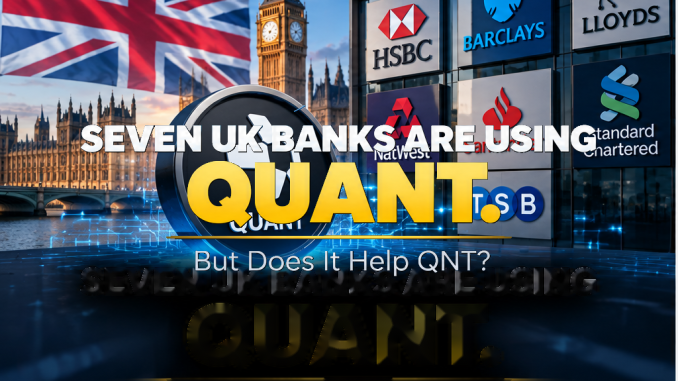
They are no longer only testing the idea of tokenised bank money. UK Finance announced on September 24 that the first live customer transactions have now been completed through its Great British Tokenised Deposit project, known as GBTD. The participating institutions include Barclays, HSBC UK, Lloyds Banking Group, Monzo, Nationwide, NatWest and Santander.
And the company that built the shared platform underneath it is Quant.
For anyone following QNT, that sounds enormous. A crypto-connected company is providing infrastructure used by some of Britain’s biggest financial institutions.
But there are really two stories here.
One is about Quant the company and its technology.
The other is about QNT the token.
They are connected. But they are not automatically the same investment story.
What actually happened?
The first transactions were surprisingly ordinary.
Two involved remortgages. Instead of money being moved manually through several steps, funds could be locked and then automatically released when the conditions for completion were met. Another transaction involved a buyer and seller in an online marketplace, where the payment could remain locked until the goods had actually been exchanged.
That may not sound revolutionary. But think about what is happening underneath.
Today, many payments happen first and problems are fixed afterwards. Money is sent, somebody checks what happened, records are reconciled and mistakes or fraud may have to be investigated.
Programmable money can change the order. The rules can be attached to the payment before the money moves.
UK Finance says the system could reduce fraud, speed up transactions and give customers more control over when money is released.
That is a real use of tokenisation. It is not a theoretical white paper anymore.
But this is not banks adopting cryptocurrency
This distinction matters.
The money being tokenised is still ordinary commercial bank money. If you have £10,000 in your bank account and part of it is represented as a tokenised deposit, the bank has not turned your pounds into Bitcoin, Ethereum or QNT.
It remains a liability of the bank.
UK Finance describes tokenised deposits as digital representations of traditional commercial bank money that retain the protections associated with conventional deposits. The technology changes how that money can move and what can be programmed into the transaction. It does not require replacing pounds with a cryptocurrency.
This is important because “banks are moving on-chain” can easily create the wrong picture.
They are not abandoning the banking system.
They are trying to give the existing banking system some of the abilities that made blockchain technology interesting in the first place.
And Quant is sitting in an interesting position
This is where the story becomes much more important for Quant.
UK Finance says the GBTD platform was built by Quant. EY provided project management, while Linklaters developed the legal advice and rulebooks. Quant says it built and operates the core infrastructure behind GBTD.
Quant’s role is essentially to help different systems talk to each other.
That matters because Barclays does not run the same internal systems as Santander. A future tokenised asset may exist on another network entirely. Central-bank settlement still has to connect to all of this, while old payment systems are not going to disappear overnight.
The difficult part may therefore not be creating another blockchain.
It may be connecting everything that already exists.
Quant has spent years positioning Overledger around exactly that problem: interoperability between different ledgers, blockchains and traditional financial infrastructure. GBTD gives the company something far more valuable than another demonstration. It gives Quant a real institutional use case involving some of the largest names in British banking.
That is significant for Quant the business.
But we still have to ask the uncomfortable question.
Does all of this actually create demand for QNT?
This is where the story becomes less simple.
Years ago, Quant made the relationship between Overledger and QNT look relatively direct. In 2021, the company announced that access to its live Overledger production platform would require an annual licence, and that the licence would be payable in QNT.
The current position is different.
Quant’s present FAQ says customers can pay their Overledger platform fee in USD or subscribe with QNT.
That is a very important sentence.
It means we cannot simply take every new bank using Quant technology, multiply that by the size of the bank, and assume the same growth must flow directly into purchases of QNT.
There may be other mechanisms connecting commercial use of Quant’s infrastructure to QNT. There may also be enterprise agreements whose terms are not public. But in the public material we reviewed for GBTD, neither UK Finance nor Quant says that Barclays, HSBC, Lloyds, Monzo, Nationwide, NatWest or Santander must buy or hold QNT to participate in these transactions.
Until that connection is demonstrated, it should not be treated as fact.
The banks may be adopting the technology without adopting crypto
There is a bigger story hiding here.
Crypto spent years arguing that blockchain technology could remove financial middlemen. But the infrastructure now being built in Britain does almost the opposite.
The banks remain.
The bank deposits remain.
Regulators remain involved.
Central-bank money remains the final anchor of the monetary system.
Even the Bank of England’s broader plan is not to replace everything with one cryptocurrency or one new form of money. It is developing what it calls a “multi-money” system where traditional deposits, tokenised bank deposits and regulated stablecoins can coexist and move between one another.
So blockchain-style technology may succeed without destroying the financial architecture it was once supposed to challenge.
The technology can change while control remains largely with regulated financial institutions.
That distinction could become one of the most important stories in crypto.
Verified
UK Finance announced on September 24, 2026 that participants in the Great British Tokenised Deposit initiative had completed the first live customer transactions using tokenised sterling deposits. Seven major banks and building societies are participating, and the transactions included remortgage completions and a consumer marketplace transaction.
UK Finance states that Quant built the GBTD platform. Quant describes itself as providing the core infrastructure connecting bank systems and tokenised infrastructure. Tokenised deposits remain commercial bank money rather than cryptocurrency, and the Bank of England expects tokenised deposits and regulated stablecoins to coexist within a broader digital-money system.
Quant’s current public FAQ states that Overledger platform fees can be paid in USD or QNT. Current public GBTD material reviewed by CryptoReality does not state that participating banks are required to buy or hold QNT as part of the programme.
Our Conclusion
This is a serious validation of Quant’s technology, but it is not yet proof of an equally large economic benefit for the QNT token.
Those two things should not be confused.
Having infrastructure used by major banks can strengthen Quant’s position, create commercial relationships and make its technology harder to dismiss as another crypto experiment. If GBTD expands into a permanent part of Britain’s payment infrastructure, that could become much more important.
But QNT holders need another piece of evidence: a clear mechanism showing how increasing institutional use of Quant’s technology creates increasing economic demand for QNT itself.
Right now, that connection is less obvious than the headline suggests.
Our Theory
Our theory is that Quant may be building something more valuable than a “crypto project.”
It may be trying to become part of the plumbing.
Banks do not necessarily care which blockchain wins. They care that their existing systems can communicate with whatever networks their customers, markets and regulators eventually use. If several different forms of digital money and tokenised assets survive, the company connecting those systems could occupy a powerful position.
That would explain why interoperability matters so much to Quant’s strategy.
But there is an important difference between owning useful financial infrastructure and owning a token connected to the company providing that infrastructure.
For QNT, the long-term question is therefore not simply:
How many banks use Quant?
It is:
When those banks use Quant more, what forces more economic value through QNT?
Until that answer becomes clearer, the biggest confirmed winner from Britain’s tokenised-deposit experiment is Quant’s technology.
Whether QNT captures the same success is still something that needs to be proven.
CryptoReality publishes independent analysis for information only. Nothing on this site is investment advice. Crypto assets are highly volatile and you can lose all of the money you invest.


