
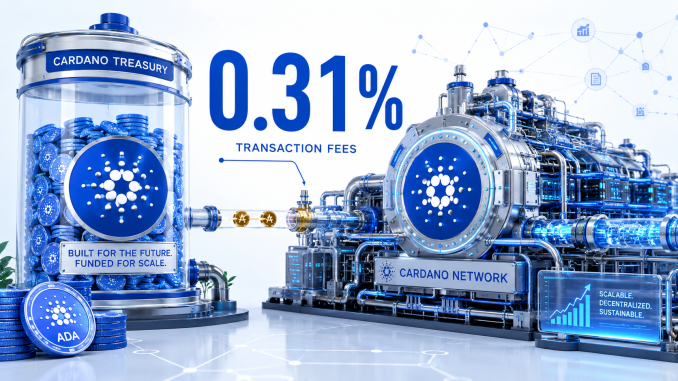
Cardano is preparing for faster transactions, more liquidity and stronger connections to Bitcoin and traditional finance. But its own numbers reveal a more basic challenge: most of the money supporting network rewards still does not come from transaction fees.
Cardano has spent years preparing for growth.
The network now has on-chain governance. Developers are working on major scaling upgrades. USDC-backed liquidity has arrived. New technology could make Bitcoin easier to use with Cardano, and regulated ADA futures are trading on CME.
There is a lot being built.
But Cardano’s own documentation raises a simpler question:
Who is paying for the network today?
The answer matters because Cardano cannot rely forever on the same source of funding it uses now.
Most of that support still comes from ADA held in the network’s reserve rather than fees generated by people using Cardano.
Most rewards still come from the reserve
Cardano pays rewards to people who help secure the network by staking ADA.
Those rewards come from two main sources: transaction fees and ADA released from the Cardano reserve.
The reserve is the difference between Cardano’s maximum supply and the ADA already in circulation or held in the treasury. A portion of the remaining reserve is released during each epoch to help fund staking rewards and the treasury.
This was built into Cardano from the beginning.
Cardano’s monetary-policy documentation explains that reserve funding was deliberately designed to play a larger role when transaction activity was still low. As usage increased, transaction fees were expected to become more important.
That transition is still far from complete.
The current Ouroboros Linear Leios proposal says that more than 85% of Cardano’s epoch rewards come from the reserve, while less than 15% come from transaction fees.
Cardano Improvement Proposal 164 — Ouroboros Linear Leios
That does not mean Cardano is about to run out of money.
The reserve was designed to decline gradually.
But it does mean that today’s network still depends heavily on ADA that was set aside earlier rather than income created by current network activity.
Eventually, users have to replace more of that support
Using reserves to help a young blockchain grow is not unusual.
When transaction activity is low, fees alone may not be enough to provide attractive rewards to the people securing the network. Subsidies give the system time to grow.
Cardano deliberately chose that approach.
But the reserve becomes smaller over time.
As that happens, more of the economic burden has to move toward real activity.
Applications need users. Users need to make transactions. Those transactions need to generate fees.
This is where the Leios proposal becomes especially interesting.
Its economic modelling says that by 2029 Cardano may need approximately 36 to 50 transactions per second, depending on transaction size and the assumptions used, as reserve contributions continue to decline.
The proposal describes roughly 36 TPS with average-sized transactions as the level needed in 2029 to replace the projected decline in reserve-funded rewards while maintaining similar reward levels.
This is not criticism from outside Cardano.
It is part of the economic reasoning behind one of the network’s most important planned upgrades.
That creates two very different problems.
Cardano needs enough capacity to process much more activity.
But it also needs enough people who actually want to use that capacity.
Leios is about more than speed
Ouroboros Linear Leios is usually described as a scaling upgrade.
That is true, but the proposal itself makes clear that scaling is also connected to Cardano’s long-term economics.
Leios is designed to allow substantially more transaction throughput while trying to preserve the security and decentralization properties of Cardano’s consensus system.
The proposal targets roughly 140,000 to 300,000 transaction bytes per second, which it describes as approximately 100 to 200 transactions per second depending on transaction size.
But capacity alone does not solve Cardano’s problem.
The Leios proposal warns against building enormous amounts of unused throughput because a more capable system also costs more to operate.
What Cardano needs is not simply a blockchain capable of processing hundreds of transactions per second.
It needs enough real activity to make that capacity useful.
As reserve funding declines, transaction fees become more important.
That means Leios may eventually matter as much for Cardano’s economics as for its speed.
The question is therefore not simply:
Can Cardano process more transactions?
It is:
Can Cardano attract enough transactions to make the network increasingly pay for itself?
Cardano is still moving forward
None of this supports the idea that Cardano has stopped developing.
On July 18, 2026, Cardano activated the van Rossem hard fork and moved to protocol version 11.
The upgrade was notable for another reason: it was the first Cardano hard fork to be proposed, debated and ratified entirely through the network’s on-chain governance process.
That is an important milestone for a project that has spent years trying to move control away from its original founding organizations and toward the network itself.
Cardano Foundation — van Rossem hard fork
Work on Leios is also continuing.
The technical side of Cardano is clearly still evolving.
The harder question is whether economic activity will grow with it.
USDCx addresses one of Cardano’s biggest weaknesses
Stablecoin liquidity has historically been one of Cardano’s weaker areas.
That matters because stablecoins are deeply integrated into the crypto economy.
They are used for trading, lending, borrowing, payments and moving money between applications. Large pools of stablecoins also make it easier for DeFi platforms to attract liquidity.
On February 27, 2026, USDCx became available on Cardano through Circle’s xReserve infrastructure.
USDCx is backed by USDC and gives Cardano users access to liquidity connected to USDC on supported blockchains.
At launch, Cardano applications including Liqwid, Minswap and SundaeSwap supported it.
That removes one obstacle.
But infrastructure and adoption are not the same thing.
Giving users a better way to bring dollar liquidity into Cardano only matters economically if they actually do it.
The important number is therefore not how many integrations are announced.
It is how much capital arrives and how often that capital gets used.
Bitcoin could open another source of liquidity
Bitcoin is another area Cardano is trying to reach.
One of the more interesting projects is CANS, short for Cyclic Atomic N-party Swaps.
The name is complicated. The basic idea is not.
CANS is designed to let multiple participants exchange assets across compatible blockchains without relying on a conventional bridge, wrapped asset or trusted intermediary.
The transaction is atomic.
Either everyone receives what they agreed to receive, or the swap does not complete.
Input Output says its reference implementation has been formally verified with as many as 20 participants and can work with blockchains that support native or verifiable Schnorr signatures.
Cardano — Introducing the CANS protocol
Bitcoin is particularly interesting because of the enormous amount of capital held in BTC.
If Bitcoin holders can use some of that value inside Cardano-based applications without relying on the bridge models common in DeFi today, Cardano could gain access to a much larger pool of potential liquidity.
But the distinction is important.
CANS creates a technical path.
It does not prove Bitcoin liquidity has already moved to Cardano at scale.
That will have to be measured through actual use.
ADA now has regulated futures on CME
Cardano has also moved further into traditional financial markets.
CME Group lists regulated ADA futures, with active contracts, trading volume and open interest.
This gives professional investors another regulated way to trade exposure to ADA.
But it would be wrong to describe that as evidence that Wall Street is buying Cardano.
Futures can be used to bet on a rising price.
They can also be used to bet on a falling price or hedge another position.
The important development is simpler:
ADA now has more established financial infrastructure around it than it did before.
Whether that translates into meaningful long-term demand is another question.
Cardano’s biggest challenge may no longer be technology
A lot of the argument around Cardano focuses on the wrong thing.
Critics point to relatively limited activity and say the project has failed.
Supporters point to Leios, governance, stablecoins, Bitcoin interoperability and years of development.
Both sides are looking at real parts of the same network.
Cardano clearly has a substantial technical roadmap.
But technology does not automatically create an economy.
The path from one to the other is straightforward:
Better infrastructure needs useful applications.
Useful applications need users.
Users need reasons to bring money onto the network.
And those users need to generate enough transactions that fees become a meaningful part of Cardano’s economics.
Cardano has spent years building the first part.
The next part is harder.
It has to persuade people to use what has been built.
ADA’s price does not answer that question
People naturally focus on ADA’s price.
Can it return to $1?
Can it reach $2?
Can it ever return to its previous all-time high?
Those questions matter to investors, but they tell us relatively little about whether Cardano itself is becoming economically stronger.
The more useful numbers are underneath the price.
Stablecoin liquidity.
DeFi activity.
DEX volume.
Active users.
Transaction throughput.
Transaction fees.
Bitcoin liquidity entering Cardano applications.
And eventually, the percentage of network rewards that can be supported by actual usage instead of the reserve.
If several of those numbers begin moving higher at the same time, Cardano’s story changes.
It would no longer be mainly a blockchain preparing for demand that may arrive later.
Demand would already be showing up.
There are two very different Cardano futures
The bullish case is easy to understand.
USDCx improves access to dollar liquidity.
CANS could open more direct paths to Bitcoin.
Leios could give the network far more capacity.
CME futures create another connection to traditional financial markets.
On-chain governance gives the Cardano community greater control over the protocol itself.
If those pieces begin reinforcing one another, Cardano could look very different in a few years.
But the bearish case is much simpler.
Cardano keeps building.
The technology gets better.
Capacity increases.
The network becomes easier to connect with other financial systems.
But users and capital do not arrive in sufficient numbers.
Then Cardano could end up with an impressive technical system that does not generate enough activity to justify everything built around it.
That is the real risk.
The question that matters
Cardano is not dead.
There is serious development happening across the network.
But there is also an economic challenge that engineering alone cannot solve.
Today, Cardano’s own Leios proposal says the reserve still provides more than 85% of epoch rewards, while transaction fees contribute less than 15%.
That balance is expected to change as the reserve declines.
For that to happen successfully, Cardano needs more than faster blocks.
It needs useful applications.
It needs capital.
It needs users.
It needs transactions.
And eventually, those transactions need to carry a much larger share of the cost of supporting the network.
That may be a better way to judge Cardano’s future than trying to predict ADA’s next price target.
Because the technology can be ready long before the demand is.
And eventually, the demand has to show up.
Sources
Cardano Docs — Monetary policy
https://docs.cardano.org/about-cardano/explore-more/monetary-policy
Cardano Improvement Proposals — CIP-0164: Ouroboros Linear Leios
https://cips.cardano.org/cip/CIP-0164
Cardano Foundation — van Rossem hard fork activation
https://forum.cardano.org/t/digest-july-22-2026-van-rossem-hard-fork-activates-constitutional-committee-election-cardano-foundation-updates-cardano-improvement-proposals-cip-updates-spotlight-on-learn-cardano-linda/155842
Circle — USDCx on Cardano via xReserve
https://www.circle.com/blog/usdcx-on-cardano-now-available-via-circle-xreserve
Cardano — Introducing the CANS protocol
https://cardano.org/news/2026-07-16-introducing-the-cans-protocol/
CME Group — ADA futures
https://www.cmegroup.com/markets/cryptocurrencies/cardano/cardano/calendar
CryptoReality publishes independent analysis for information only. Nothing on this site is investment advice. Crypto assets are highly volatile and you can lose all of the money you invest.