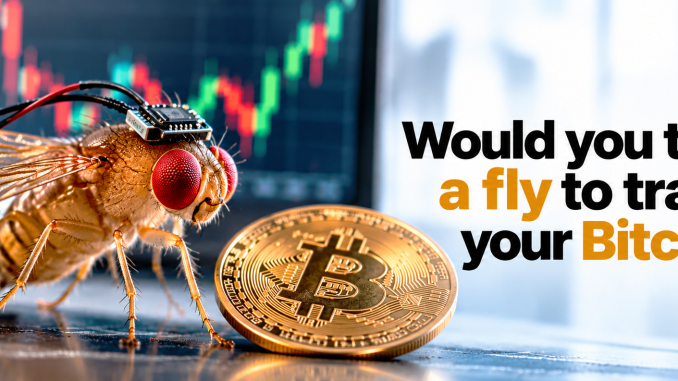
A fruit fly brain trading Bitcoin sounds like something invented for clicks. But StonkFly is a real open-source experiment.
The project uses a computer simulation built from the nervous system of a male fruit fly. It contains 166,700 neurons and about 25.6 million connections. Market charts are shown to the simulated visual system, and its neural activity is turned into one of three decisions: buy, sell or hold.
That makes StonkFly interesting.
But it does not automatically make the STONKFLY token a good investment.
How does StonkFly actually work?
The basic idea is surprisingly simple.
StonkFly takes real market prices and turns them into a chart that the simulated fly can “see.” Activity inside the nervous system is then measured. A fixed system translates that activity into a buy, sell or hold signal.
There is no large language model secretly deciding what to trade. The developers also make clear that they have not discovered special “buy neurons” or “sell neurons.” Humans chose how certain neural signals would be translated into trading actions.
The original public code uses real BTC-USDC market data in paper-trading mode. It can also be connected to Coinbase Advanced for real trades, but that requires a user to provide their own account, credentials and money and deliberately turn live trading on.
VERIFIED
StonkFly is a real experiment with public code. The fly-brain simulation really produces signals that can be translated into trading decisions. This part is not simply marketing.
Is the fly actually good at trading?
This is where the headline becomes much less exciting.
StonkFly can react to profits and losses. When the simulated portfolio gains value, certain dopamine-related cells receive a reward signal. Losses trigger a different signal. Some connections inside the simulated network can then change.
But changing connections is not the same thing as learning how to make money.
The project’s own documentation says it clearly: profitable learning has not been demonstrated. There is no proof yet that StonkFly becomes a better trader over time or can consistently beat a simple trading strategy.
That is an important detail that can easily disappear when the story becomes “a fly brain is trading Bitcoin.”
VERIFIED
The simulated brain can make trading decisions and its internal connections can change after gains and losses. There is no verified evidence yet that those changes create profitable trading ability.
Why are some people seeing stocks instead of Bitcoin?
Because StonkFly is already changing.
The current official StonkFly website presents a version that watches markets linked to companies such as NVIDIA, Tesla, Apple, Amazon, Microsoft and Alphabet through Lighter. The site describes the orders as paper only.
At the same time, the public GitHub code still documents BTC-USDC trading through Coinbase and optional support for ETH-USDC and SOL-USDC.
So if you see one person talking about Bitcoin and another talking about stocks, both can be referring to StonkFly. They are looking at different versions of the experiment.
Then there is the STONKFLY token
This is where people need to separate the technology from the crypto token.
The official StonkFly website lists a STONKFLY community token launched through Pons Family on Robinhood Chain.
The official contract shown by StonkFly is:
0x1315387460A073feB1a15bA5AEFEC127726b4763
The project’s own website also says that the token gives holders no rights to trading profits or project revenue. It promises no returns and no token buybacks.
That changes how the token should be viewed.
Buying STONKFLY does not mean you own part of the fly-brain technology. It does not mean you receive money if the experiment one day becomes profitable. And it does not give you ownership of the software.
OUR CONCLUSION
The experiment has a clear reason to exist. The token has a much weaker reason to exist.
Right now, the strongest thing connecting the token to the experiment is the StonkFly name and community around it.
So why could the token still rise?
Attention.
StonkFly has almost everything needed for a viral crypto story: Bitcoin, artificial intelligence, neuroscience and a fruit fly making trades.
That combination can bring buyers into a token very quickly.
But attention is not the same thing as utility.
If the main reason people buy STONKFLY is because the story is unusual and viral, the same buyers can disappear when attention moves somewhere else.
OUR THEORY
The STONKFLY token may currently depend more on interest in the story than on economic value created by the token itself.
That can still create strong price moves. It also creates substantial risk.
Is StonkFly a scam?
We have not found evidence that the official StonkFly project is a scam.
The developer and code are public. The project openly says that profitable learning has not been proven. It also clearly tells buyers that the token gives no rights to trading profits or project revenue.
Those facts matter.
But “not a proven scam” does not mean “safe.”
A real project can still have a highly speculative token.
CR RADAR assessment
CR Risk: HIGH
CR Potential: LOW
Confidence: MEDIUM
The technology behind StonkFly is real and unusual. The experiment may become far more interesting if researchers eventually show that its simulated nervous system can genuinely improve through experience.
But the token is a separate question.
Right now, STONKFLY gives holders no share of the technology, trading profits or revenue. We also want more trading history and reliable on-chain data before making stronger conclusions about ownership concentration and exit risk.
The most important thing is therefore very simple:
The fly is real. The experiment is real. Profitable trading has not been proven. And none of that automatically gives the STONKFLY token value.
Sources
1. StonkFly — Original GitHub Repository Projektets offentliga källkod och dokumentation. https://github.com/nftechie/stonkfly
2. StonkFly — Technical Model Documentation Förklarar simuleringen med 166 700 nervceller, 25,6 miljoner kopplingar och hur köp- och säljsignaler skapas. https://github.com/nftechie/stonkfly/blob/main/docs/model.md
3. StonkFly — Trading, Paper Mode and Risk Controls Dokumentation om BTC-USDC, Coinbase, simulerade affärer och villkor för riktig handel. https://github.com/nftechie/stonkfly/blob/main/docs/operations.md
4. StonkFly — Original README Bekräftar att projektet ännu inte har visat att nervsystemet kan lära sig handla lönsamt. https://github.com/nftechie/stonkfly/blob/main/README.md
5. StonkFly — Scientific Sources and Attribution Dokumentation av forskning och datamaterial bakom simuleringen. https://github.com/nftechie/stonkfly/blob/main/THIRD_PARTY.md
6. Tom’s Hardware — Engineer Turns Simulated Fly Brain Into a Crypto Day Trader Oberoende rapportering om experimentet. https://www.tomshardware.com/tech-industry/artificial-intelligence/engineer-turns-simulated-fly-brain-into-a-crypto-day-trader-posts-downloadable-sim-to-github-166-700-virtual-neurons-read-candlestick-charts-for-dopamine-hits
CryptoReality publishes independent analysis for information only. Nothing on this site is investment advice. Crypto assets are highly volatile and you can lose all of the money you invest.


