You Can Still Buy Bitcoin Without KYC. That Doesn’t Mean You’re Anonymous.
There is a persistent idea in crypto that goes something like this:
If I buy Bitcoin without giving an exchange my passport, nobody can know that the Bitcoin belongs to me.
It sounds logical.
No account.
No passport.
No selfie.
No KYC.
Therefore, no identity.
But that conclusion skips over something important.
Your identity does not have to be written on the blockchain for someone to connect you to a wallet.
And in 2026, there are far more ways of making that connection than many crypto users seem to realise.
So we decided to investigate a simple question:
Can an ordinary person still buy cryptocurrency anonymously in 2026?
We examined current European regulations, no-KYC peer-to-peer markets, Bitcoin’s own privacy documentation, blockchain-analysis methods and recent law-enforcement cases.
The answer is more complicated than either side of the debate usually admits.
Yes, it is still possible to acquire Bitcoin without conventional KYC.
But:
No KYC is not the same thing as anonymity.
And depending on how the transaction is made — and what happens to those coins later — an apparently anonymous purchase can leave a surprisingly detailed trail.
First, We Need to Define “Anonymous”
Crypto discussions regularly mix together four very different concepts:
No KYC
A service does not require conventional identity verification such as a passport, national ID or facial verification.
Pseudonymous
Your activity is associated with an identifier — such as a Bitcoin address — rather than directly with your real name.
Private
Some information about your activity is difficult for outsiders to observe or connect.
Anonymous
An observer cannot reasonably determine who is behind the activity.
These are not interchangeable.
Bitcoin, for example, is fundamentally pseudonymous, not anonymous.
A Bitcoin address might look like this:
bc1q...
There is no field next to it saying:
John Smith, Stockholm, Sweden.
That is true.
But the transaction itself can still reveal:
- the sending address
- the receiving address
- the amount transferred
- when the transaction occurred
- the previous history of the coins
- where those coins move next
And that information does not disappear.
Bitcoin.org itself warns that all Bitcoin transactions are public, traceable and permanently stored in the Bitcoin network. It also specifically warns that something which cannot be traced today could become easier to trace in the future.
That last point changes the entire anonymity discussion.
A transaction does not necessarily need to reveal your identity today.
It only needs to become connected to your identity once.
Our Test: Follow the Data, Not the Marketing
Instead of asking whether a platform advertises itself as “private” or “no KYC”, consider what actually happens to the information.
Imagine someone we will call Alex.
Alex wants to buy Bitcoin.
He does not want to use Coinbase, Kraken or another conventional exchange because he does not want to submit a passport.
So Alex does three things:
- creates a self-custody Bitcoin wallet;
- finds a peer-to-peer Bitcoin seller;
- buys Bitcoin without conventional KYC.
At first glance, Alex appears anonymous.
But now we follow the data.
Step 1: Alex Creates a Bitcoin Wallet
This is probably the most genuinely pseudonymous part of the process.
A self-custody Bitcoin wallet can generate addresses without asking Bitcoin itself for:
- your name
- passport number
- home address
- national identification number
- employment information
The Bitcoin network does not maintain a customer database matching addresses to people.
So at this exact moment, Alex’s newly generated address may have no publicly known connection to Alex.
That is important.
But it does not mean that the wallet is permanently anonymous.
It means something narrower:
Nobody has necessarily connected the wallet to Alex yet.
The distinction matters enormously.
Once the wallet begins interacting with other people, companies, exchanges and payment systems, information starts accumulating.
Step 2: Alex Finds a “No-KYC” Market
This is where many people believe the anonymity question has already been solved.
There are still peer-to-peer markets where conventional exchange-style KYC is not required.
For example, Bisq describes Bitcoin trading with no KYC and peer-to-peer fiat exchange. Its documentation explicitly refers to helping users acquire “no KYC bitcoin”.
That is real.
But look more closely at what happens when traditional money is involved.
Bisq’s own documentation explains that when fiat payments are used, buyers and sellers may reveal payment-account information to one another. In Bisq Easy, for example, the seller sends payment-account details to the buyer, and the documentation explicitly acknowledges the privacy trade-off involved when bank-account information is transmitted between traders.
This is the first critical distinction.
The marketplace may not know Alex’s government identity.
But another participant might.
His bank might.
The recipient’s bank might.
His payment provider might.
And that is enough to create possible links between the traditional financial system and the blockchain.
No KYC has only removed one identity checkpoint.
It has not necessarily removed the identity trail.
Step 3: Alex Pays by Bank Transfer
This is where the idea of anonymous Bitcoin buying often begins to fall apart.
Suppose Alex buys €500 worth of Bitcoin from another person.
Alex sends the seller €500 using his ordinary bank account.
The Bitcoin arrives in Alex’s self-custody wallet.
There is no Coinbase account.
There is no cryptocurrency exchange account under Alex’s name.
There was no passport verification.
From Alex’s perspective, the purchase feels anonymous.
But consider the two records that now exist.
The banking system may know:
Alex → €500 → recipient → date/time
Meanwhile, the blockchain records:
Bitcoin address A → Bitcoin address B → BTC amount → date/time
The bank record and blockchain record are separate.
But separate databases do not mean unrelated databases.
The analytical question becomes:
Can information outside the blockchain help identify the entity behind an address on the blockchain?
And the answer is very clearly yes.
This Is Where Blockchain Analytics Enters
Blockchain analysis is often misunderstood as some magical system that looks at a Bitcoin address and instantly produces the owner’s name.
That is not how it works.
A more accurate model has two stages.
Stage 1: Clustering
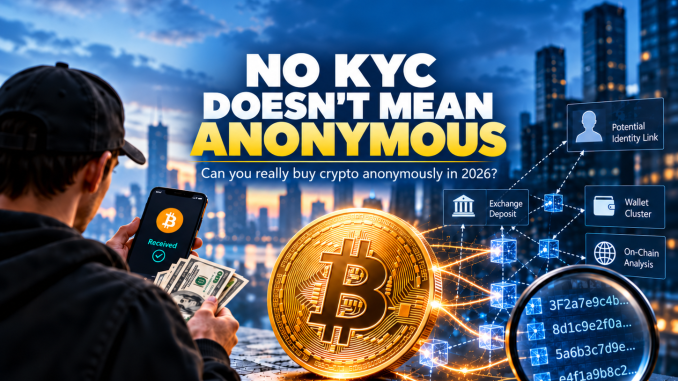
Analysts examine blockchain behaviour to determine which addresses may be controlled by the same wallet, service or entity.
Stage 2: Attribution
Analysts combine blockchain information with information from outside the blockchain to determine who or what may control those addresses.
Chainalysis describes wallet attribution as combining on-chain analysis with off-chain evidence.
Sources can include:
- information from exchanges
- KYC records obtained through lawful processes
- seized infrastructure or wallets
- known service addresses
- open-source information
- previously identified addresses
- other investigative evidence
The important point is that identity does not need to exist on the blockchain itself.
The identity can come from somewhere else and then be attached to the blockchain history.
That is the bridge between:
0x… / bc1…
and
a real person or organisation.
The Blockchain Doesn’t Forget
This may be the single most misunderstood aspect of crypto privacy.
Imagine Alex successfully buys Bitcoin without KYC.
Nobody connects the wallet to him.
One month passes.
Nothing happens.
One year passes.
Still nothing.
Alex concludes:
“See? It was anonymous.”
Not necessarily.
Suppose years later Alex sends part of those Bitcoin to a regulated cryptocurrency exchange where he has completed identity verification.
The exchange now knows which customer received that particular deposit.
Blockchain investigators can also see where the deposit came from.
That does not automatically prove that every previous address belongs to Alex.
Blockchain attribution has uncertainties, and professional investigators should distinguish between evidence and assumptions.
But something important has happened.
An identity anchor has appeared.
The previous blockchain history did not disappear when Alex identified himself later.
It was sitting there the entire time.
Bitcoin.org explicitly warns users about this property: transactions are permanently recorded, meaning activity that may be difficult to trace now can potentially become easier to analyse later.
This creates a strange property that cash does not have.
With cash, investigators normally need to reconstruct what happened in the past using receipts, witnesses, cameras and records.
With Bitcoin, much of the transaction graph is already preserved.
They may simply be missing the identity.
When the identity appears later, old transactions can become relevant again.
One Identity Leak Can Change the Picture
Think about a wallet containing ten addresses.
To the outside world they initially look like ten unrelated strings of characters.
Then one address interacts with something that provides strong information about its owner.
Now analysts may have a starting point.
They can examine:
- transaction relationships
- common spending patterns
- previous transactions
- later transactions
- interactions with known services
- associated address clusters
This does not mean blockchain analysis is infallible.
It isn’t.
Chainalysis itself notes that wallet attribution requires confidence levels and that an address should not automatically be treated as a person. Exchanges, for example, can control addresses holding funds for thousands of customers.
That distinction is important.
But it also shows why saying:
“There is no name on my wallet.”
is not a meaningful test of anonymity.
Law Enforcement Is Already Doing This in the Real World
This isn’t theoretical.
On February 24, 2026, the U.S. Attorney’s Office for the Eastern District of North Carolina announced the seizure of more than $61 million in Tether connected to alleged cryptocurrency investment fraud.
According to the Justice Department, criminals had routed funds through multiple cryptocurrency wallets in an attempt to obscure the source, ownership and control of the money.
Investigators nevertheless traced victims’ funds through multiple wallets and identified assets that could be seized.
Another case announced in July 2026 involved cryptocurrency connected to fraud victims.
Law enforcement said that funds were traced to a cryptocurrency wallet, and investigators then identified additional victims whose funds could be traced to the same wallet.
And on July 21, 2026, the U.S. Attorney’s Office in Washington announced five civil forfeiture actions involving more than $25 million in cryptocurrency recovered from separate fraud investigations.
The U.S. Secret Service specifically described investigators as tracing illicit cryptocurrency transactions.
None of this means every cryptocurrency transaction can always be attributed to a person.
It demonstrates something narrower — but extremely important:
Moving cryptocurrency between wallets does not automatically destroy the forensic trail.
What About Buying Bitcoin With Cash?
This is where the answer becomes more nuanced.
Cash can remove one important digital link:
the bank-payment record.
If two individuals exchange cash directly for cryptocurrency, there may be no bank transfer connecting the buyer to the seller.
That can create substantially more financial privacy than buying through a regulated exchange.
But it still does not magically make the resulting Bitcoin invisible.
The blockchain transaction remains.
And there can be other forms of evidence outside the blockchain depending on the circumstances.
The crucial distinction is therefore:
Cash may remove one source of attribution.
It does not remove the blockchain.
Nor does it guarantee that no other attribution source exists.
That is why claiming that a cash purchase is automatically “untraceable” would be wrong.
What About a Pure Wallet-to-Wallet Transaction?
There is another interesting point.
Under the EU’s current Transfer of Funds Regulation, a genuine person-to-person cryptocurrency transfer made without the involvement of a crypto-asset service provider falls outside that regulation’s Travel Rule requirements.
The legislation explicitly says this.
That means the EU has not banned people from simply transferring crypto between their own wallets or directly between individuals.
But again:
Exempt from that particular Travel Rule requirement does not mean anonymous.
The blockchain transaction still exists.
And other laws and obligations can still apply depending on the circumstances and jurisdiction.
Self-Custody Is Not the Same Thing as Anonymity
This misconception is also common.
A self-custody wallet means:
You control the private keys.
It does not mean:
Nobody can associate the wallet with you.
Those are completely separate properties.
This distinction is increasingly visible in European regulation.
EU Regulation 2023/1113 applies when a crypto-asset service provider is involved in a transfer to or from a self-hosted address.
For transfers exceeding €1,000 to or from a self-hosted address, the regulated provider must take appropriate measures to assess whether that address is owned or controlled by its customer.
Notice what regulators are doing.
They are building connections between:
customer identity
and
external blockchain addresses.
That information is precisely the type of information that can make pseudonymous blockchain activity much easier to understand.
The €1,000 Rule Is Often Misunderstood
There is another important detail.
People sometimes interpret the €1,000 figure as:
“Under €1,000, crypto transfers are anonymous.”
That is not what the regulation says.
When a regulated crypto-asset service provider is involved, information requirements concerning the originator and beneficiary still apply.
The €1,000 threshold specifically triggers additional measures concerning whether a self-hosted address is actually owned or controlled by the customer.
It is not an anonymity allowance below €1,000.
That distinction matters.
Sweden Has Already Tightened the Regulated Side of the Market
For Swedish users, another major change occurred very recently.
The MiCA transition period ended at the end of June 2026.
Sweden’s Finansinspektionen stated on July 1, 2026 that companies without the required authorisation should no longer continue providing crypto-asset services to consumers in Sweden and the EU under the expired transitional regime.
Finansinspektionen advises consumers to verify that crypto providers are authorised under MiCA.
So while pure peer-to-peer transfers continue to exist, the regulated gateway between traditional money and crypto is becoming increasingly formalised.
And Another Major EU Change Arrives in 2027
The direction of travel is even clearer when we look ahead.
EU Regulation 2024/1624 begins applying on 10 July 2027 for most covered entities.
Article 79 prohibits regulated financial institutions and crypto-asset service providers from maintaining anonymous crypto-asset accounts or other accounts that allow customer holders or transactions to be anonymised or increasingly obscured, including through anonymity-enhancing coins.
This does not mean private ownership of Bitcoin becomes illegal.
It does mean the regulated financial infrastructure surrounding crypto is moving further away from anonymous customer relationships.
The Global Direction Is the Same
This is not only an EU phenomenon.
On 16 July 2026, the Financial Action Task Force published its seventh targeted update on virtual assets.
FATF reported that 83% of surveyed jurisdictions had passed legislation implementing the Travel Rule, compared with 73% in 2025.
The organisation also specifically identified risks involving:
- peer-to-peer transfers
- unhosted wallets
- offshore virtual-asset providers
- stablecoins
- DeFi
as areas receiving continued regulatory attention.
In March 2026, FATF separately published a report devoted specifically to stablecoins and peer-to-peer transactions involving unhosted wallets.
The direction is difficult to miss.
The regulated crypto economy is becoming more attributable, not less.
So How Anonymous Are the Most Common Ways of Buying Crypto?
The following table is intentionally simplified, because actual privacy depends on the exact service, jurisdiction and circumstances.
| Purchase route | Conventional KYC | Fiat identity trail | Public blockchain trail | Truly anonymous? |
|---|---|---|---|---|
| Regulated centralised exchange | Usually yes | Strong | Yes | No |
| No-KYC P2P + bank transfer | Possibly no | Strong | Yes | Generally no |
| P2P + other identifiable digital payment | Possibly no | Often significant | Yes | Generally no |
| Direct cash-for-crypto transaction | Possibly no | Lower | Yes | Potentially more private, but not guaranteed anonymous |
| Wallet-to-wallet crypto transfer | No KYC inherently required | None created by blockchain itself | Yes | Pseudonymous, not automatically anonymous |
| Self-custody wallet | No KYC required to create | None inherently | Yes once used | Pseudonymous |
The distinction becomes obvious once everything is placed side by side.
The question is not:
“Did the crypto platform ask for my passport?”
The better question is:
“What information exists that could connect this wallet to me?”
That is a completely different privacy test.
The Most Dangerous Myth: “I Used a Different Wallet”
Another common belief is:
“I moved the Bitcoin to another wallet, so the connection is gone.”
On a public blockchain, moving assets normally creates another transaction.
It does not erase the previous transaction.
Imagine:
Known source → Wallet A → Wallet B → Wallet C
The blockchain does not show:
Wallet C appeared from nowhere.
It preserves the transaction graph.
Blockchain-analysis systems are specifically designed to analyse those graphs.
Chainalysis describes transaction-graph analysis as following fund flows from originating wallets through subsequent transactions toward later destinations.
This does not mean every chain of transactions can always be attributed with certainty.
But simply adding addresses should not be confused with deleting history.
There is no delete button on Bitcoin.
Another Myth: “Nobody Knows My Wallet Today”
That word — today — matters.
Suppose your wallet is genuinely unattributed right now.
That still does not guarantee future anonymity.
Tomorrow you might:
- deposit crypto at a regulated exchange
- withdraw from a regulated service
- pay a merchant that knows your identity
- publish an address online
- interact with another already-attributed wallet
- become connected through evidence obtained elsewhere
Again, none of these automatically proves ownership of every connected wallet.
But each can create another piece of the attribution puzzle.
Because the blockchain is permanent, future information can increase what analysts understand about past transactions.
This is fundamentally different from assuming:
“Nobody identified me when I made the transaction, therefore nobody ever can.”
That assumption is unsafe.
KYC Is Only One Layer of Identity
This may be the biggest conclusion from our investigation.
Crypto users often think about identity as a binary switch:
KYC = identified
No KYC = anonymous
Reality looks more like this:
Layer 1 — Platform identity
Did the marketplace verify your identity?
Layer 2 — Payment identity
Did a bank, card company, payment processor or counterparty know who paid?
Layer 3 — Network and device information
Did services involved in the transaction generate technical records?
Layer 4 — Blockchain activity
Which addresses interacted with which other addresses?
Layer 5 — Counterparty information
What does the person on the other side of the transaction know?
Layer 6 — Future attribution
Does the wallet later interact with a service or entity connected to a known identity?
An anonymous purchase would require much more than simply removing Layer 1.
That is why “no KYC” is a very poor synonym for “anonymous.”
This Doesn’t Mean Blockchain Analytics Is Omniscient
There is another mistake we should avoid.
It would be equally misleading to claim:
“Every wallet can be traced to its owner.”
That is not true either.
A blockchain shows addresses and transactions.
It does not inherently know who owns them.
Professional attribution involves evidence, inference and varying confidence levels.
Wallet clustering can produce uncertainty.
Services may control addresses on behalf of many customers.
Transactions can become technically complicated.
Different blockchains reveal different information.
And some privacy technologies can make analysis substantially harder.
Even Chainalysis emphasises that attribution should distinguish between confidence levels rather than automatically treating every suspected link as fact.
The correct conclusion is therefore not:
“Crypto is perfectly traceable.”
Nor is it:
“Crypto is anonymous.”
The reality sits in between:
Public blockchain activity is pseudonymous, permanently recorded and often highly traceable once enough external information becomes available.
Cash and Bitcoin Are Fundamentally Different
Imagine someone hands another person a €50 note.
The note does not create a globally replicated public database containing:
- previous owner
- next owner
- exact transfer time
- subsequent movements of that value
Bitcoin does.
This is one reason Europol has explicitly rejected the idea that cryptocurrencies are inherently anonymous.
Europol notes that transactions on most public blockchains are recorded on a public ledger and can therefore be traced, giving investigators information that does not exist in the same form when dealing with cash.
That does not make Bitcoin bad.
Transparency is one of Bitcoin’s fundamental properties.
But calling that system “anonymous money” without qualification is misleading.
So, Can You Really Buy Bitcoin Anonymously in 2026?
Here is the most accurate answer we can give.
Can you buy Bitcoin without submitting a passport to a cryptocurrency exchange?
Yes.
Peer-to-peer markets and direct person-to-person transactions still exist.
Can you create a self-custody wallet without providing your identity to Bitcoin?
Yes.
Can Bitcoin addresses exist without a publicly attached real-world name?
Absolutely.
Does that make the resulting Bitcoin impossible to connect to you?
No.
Does a no-KYC purchase guarantee anonymity?
No.
Does moving Bitcoin to another wallet erase the transaction history?
No.
Can blockchain activity sometimes remain unattributed?
Yes.
Can previously pseudonymous activity later become associated with a real-world identity?
Yes.
And that final point is probably the most important one.
The Real CryptoReality
When someone says:
“I bought my Bitcoin anonymously.”
ask one question:
Anonymous from whom?
Anonymous from the marketplace?
Perhaps.
Anonymous from the seller?
Maybe not.
Anonymous from the bank?
Probably not if a bank transfer was used.
Anonymous from the blockchain?
The transaction is public.
Anonymous from blockchain-analysis companies?
Unknown.
Anonymous from a future exchange where the coins eventually arrive?
Possibly not.
Anonymous from an investigator who combines blockchain data with banking records, exchange records, seized information or other evidence?
Again, not necessarily.
That is why the simple statement:
“I didn’t do KYC, so my Bitcoin can’t be traced to me.”
is not technically defensible.
The more accurate statement would be:
“I bought Bitcoin without conventional KYC, and my wallet may currently not be publicly attributed to my identity.”
Those two sentences sound similar.
They describe completely different realities.
Bottom Line
Bitcoin can provide meaningful financial privacy.
Self-custody can remove dependence on a financial intermediary.
Peer-to-peer exchange can reduce how much personal information is concentrated in a cryptocurrency company.
Those are legitimate and important properties.
But none of them changes Bitcoin’s fundamental architecture.
The ledger is public.
The transaction history is permanent.
The identity can come from somewhere outside the blockchain.
And once an identity and a wallet become convincingly connected, the blockchain may contain something cash almost never provides:
a permanent history waiting to be analysed.
So yes:
You can still buy Bitcoin without KYC in 2026.
Just don’t confuse that with being invisible.
CryptoReality Note
This article examines cryptocurrency privacy, blockchain traceability and current regulation for educational purposes. It is not intended as instructions for concealing criminal proceeds, evading taxes, sanctions, anti-money-laundering controls or law-enforcement investigations. Laws and regulatory requirements vary by jurisdiction and can change.
Sources and Further Reading
Bitcoin.org — Protect Your Privacy / Bitcoin Is Not Anonymous
Bitcoin’s own documentation explains that Bitcoin transactions are public, traceable and permanently recorded.
Regulation (EU) 2023/1113 — Information Accompanying Transfers of Funds and Crypto-assets
Primary EU legislation covering Travel Rule requirements, self-hosted addresses and the P2P exemption where no crypto-asset service provider is involved.
Regulation (EU) 2024/1624 — EU Anti-Money-Laundering Regulation
Includes Article 79 concerning anonymous crypto-asset accounts and applies from 10 July 2027 for most covered entities.
Financial Action Task Force — Seventh Targeted Update, July 16, 2026
Latest FATF assessment of global implementation of virtual-asset regulation and the Travel Rule.
FATF — Stablecoins and Unhosted Wallets / P2P Transactions, March 2026
Current FATF work specifically examining P2P activity involving unhosted wallets.
Europol — Debunking the Myth that Cryptocurrency Provides Anonymity
Europol explains the forensic value of public blockchain records.
Chainalysis — Wallet Attribution and Blockchain Forensics
Technical explanation of address clustering, entity attribution and combining on-chain activity with off-chain evidence.
Bisq Documentation — Bisq Easy / Account Limits
Documentation demonstrating that no-KYC Bitcoin trading exists while also explaining the privacy trade-offs created by fiat payment-account information.
U.S. Department of Justice — $61 Million Cryptocurrency Seizure, February 24, 2026
Recent real-world example of investigators tracing funds through multiple cryptocurrency wallets.
Finansinspektionen — MiCA Transition Ended, July 1, 2026
Current Swedish regulatory position concerning authorised crypto-asset service providers.
Bitcoin.org — Protect Your Privacy / Bitcoin Is Not Anonymous
Regulation (EU) 2023/1113 — Information Accompanying Transfers of Funds and Crypto-assets
Regulation (EU) 2024/1624 — EU Anti-Money-Laundering Regulation
Financial Action Task Force — Seventh Targeted Update, July 16, 2026
FATF — Stablecoins and Unhosted Wallets / P2P Transactions, March 2026
Europol — Debunking the Myth that Cryptocurrency Provides Anonymity
Chainalysis — Wallet Attribution and Blockchain Forensics
Bisq Documentation — Bisq Easy / Account Limits
U.S. Department of Justice — $61 Million Cryptocurrency Seizure, February 24, 2026
Finansinspektionen — Kryptobolag utan tillstånd ska avveckla sin verksamhet i EU
Read next
- What If Your Hardware Wallet Is the Hacker?
- A $95 Million Crypto Surveillance Contract — And Now Chainalysis Is Suing
- Zcash ETF Hit $500M. But That Is Not $500M of New Money.
CryptoReality publishes independent analysis for information only. Nothing on this site is investment advice. Crypto assets are highly volatile and you can lose all of the money you invest.