
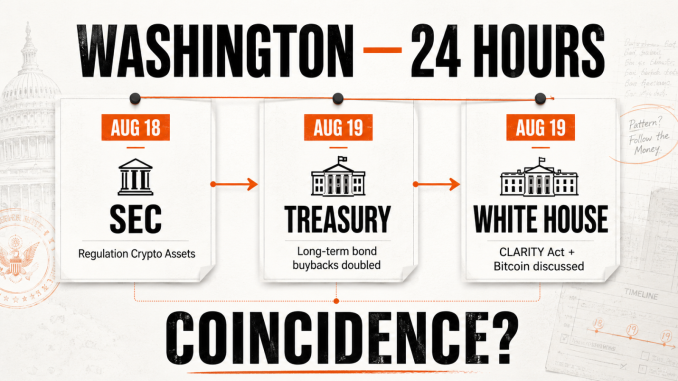
The SEC proposed new crypto rules. Treasury doubled long-term bond buybacks. Trump pushed the CLARITY Act and left the door open to more U.S. Bitcoin accumulation. Then yields fell, the dollar weakened — and Bitcoin jumped.
Something unusual happened in Washington this week.
Not one major development.
Three.
And they arrived within roughly 24 hours.
On August 18, the Securities and Exchange Commission proposed a new regulatory framework specifically designed for crypto assets.
On August 19, the U.S. Treasury unexpectedly announced that it would at least double the size of certain long-term Treasury bond buybacks.
Later that same day, President Donald Trump appeared with major crypto and financial executives at the White House, urged Congress to pass the CLARITY Act and, when asked whether the United States might accumulate significantly more Bitcoin, said the idea had been discussed.
Then markets moved.
Long-term Treasury yields fell sharply.
The dollar weakened.
Gold rose.
Bitcoin surged.
Look at each event separately and there are perfectly reasonable explanations.
Put them next to each other, however, and a more interesting question emerges:
Did Washington just send three different signals pointing in the same direction?
The Timeline
The sequence matters.
August 18 — SEC proposes Regulation Crypto Assets
The SEC formally proposed Regulation Crypto Assets, a new framework designed specifically for certain investment contracts involving crypto assets.
Among other things, the proposal would create:
- a startup exemption allowing certain offerings of up to $5 million over four years;
- a fundraising exemption allowing offerings of up to $75 million during a 12-month period;
- tailored disclosure requirements;
- and a conditional safe harbor that could allow a crypto asset to cease being treated as part of an investment contract once specified conditions are satisfied.
The proposal is subject to a public-comment period before it can become final.
This is important because the SEC is no longer simply trying to fit crypto into rules written for conventional securities markets.
It is proposing a framework specifically designed around crypto.
That is a significant change in regulatory direction.
August 19 — Treasury Makes a Surprise Move in the Bond Market
The next day, something happened outside crypto.
The U.S. Treasury announced that it would at least double the maximum size of liquidity-support buybacks for longer-dated Treasury securities.
The affected maturities are:
10–20 years
and
20–30 years.
The current maximum of $2 billion per operation will rise to at least $4 billion per operation beginning September 9.
The expanded program is scheduled to remain in effect through November 4.
Treasury’s stated reason was straightforward:
provide greater liquidity support in longer-dated Treasury markets.
That explanation matters.
Because almost immediately, another interpretation began spreading online:
“The U.S. just started QE again.”
That is not accurate.
This Is Not QE
Quantitative easing is normally conducted by the Federal Reserve, which creates reserves and purchases securities as part of monetary policy.
This Treasury program is different.
Treasury is repurchasing its own outstanding debt as part of its debt-management operations.
There is no evidence that the Federal Reserve suddenly launched a new QE program.
Reuters made the distinction explicitly: the scale of the buybacks is relatively small compared with the enormous Treasury market, the increase is temporary, and the operation does not change the average maturity of government debt.
So:
Treasury buybacks ≠ Federal Reserve QE.
But that does not mean the announcement was irrelevant.
Quite the opposite.
Markets reacted immediately.
The Bond Market Reacted First
Long-term U.S. yields dropped by as much as roughly 10 basis points after the announcement.
The yield curve flattened.
The dollar fell.
Reuters reported the dollar down around 0.8% on the day.
Gold surged.
And Bitcoin rose about 5%.
That connection is economically understandable.
When long-term yields fall, the relative attraction of holding risk-free government debt can decline.
A weaker dollar can also support assets priced in dollars.
And improving financial conditions can encourage investors to move further out on the risk curve.
Bitcoin sits directly inside that ecosystem.
But then Washington added another signal.
August 19 — Crypto Executives Enter the White House
While markets were digesting Treasury’s bond announcement, President Trump was meeting some of the most powerful people in American crypto and finance.
The White House gathering included executives from companies such as:
- Coinbase
- Robinhood
- Kraken
as well as senior U.S. regulators including SEC Chair Paul Atkins and CFTC Chair Mike Selig.
Trump used the event to publicly pressure Congress.
His message was clear:
Congress should pass a “fair version” of the CLARITY Act.
The legislation is intended to establish clearer boundaries between securities and commodities and clarify which U.S. regulator has authority over different parts of the crypto market.
That alone would have been a significant political signal.
Then came the question about Bitcoin.
“Does the Administration Have Any Plans to Accumulate Sizable Amounts of Bitcoin?”
A reporter asked Trump directly whether the administration planned to accumulate sizable amounts of Bitcoin or other crypto assets.
Trump did not announce a Bitcoin purchase.
That distinction is important.
Instead, he replied:
“Well, it’s been talked about.”
He went on to say that he would listen if his advisers and regulators came to him with recommendations.
That may sound vague.
But the context makes it considerably more interesting.
The United States Already Has a Strategic Bitcoin Reserve
This discussion did not appear out of nowhere.
On March 6, 2025, Trump signed an executive order establishing the Strategic Bitcoin Reserve.
Bitcoin entering the reserve through government forfeitures is not to be sold under the terms of the order and is instead held as a U.S. reserve asset.
But there is another provision that receives much less attention.
The executive order instructs the Treasury Secretary and Commerce Secretary to develop strategies for acquiring additional Bitcoin, provided those strategies are:
budget neutral
and
impose no incremental costs on U.S. taxpayers.
So when Trump said on August 19 that additional Bitcoin accumulation had “been talked about,” the idea itself was not new.
There is already an executive instruction telling parts of the government to investigate how additional Bitcoin could potentially be acquired.
What remains unknown is whether such a strategy will actually be implemented.
Now Put the Three Events Together
Within roughly one day, Washington produced three separate developments.
1. Regulatory
The SEC proposed a crypto-specific capital-raising framework.
2. Monetary-market environment
Treasury expanded long-term bond buybacks, pushing yields and the dollar lower initially.
3. Political
The President publicly pushed Congress toward broader crypto legislation while confirming that further U.S. Bitcoin accumulation has been discussed.
Then:
Bitcoin rallied sharply.
Looked at individually, none proves anything extraordinary.
Together, however, they changed the market environment in several different ways at almost exactly the same time.
Then the Shorts Started Breaking
Bitcoin had spent weeks trading in a relatively compressed range.
That meant a large number of leveraged traders had positioned themselves for continued weakness.
When Bitcoin began moving higher, some of those positions were forced to close.
A short seller profits when an asset falls.
But when the asset rises sufficiently, leveraged short positions can be liquidated.
Closing those positions requires buying.
That creates an important feedback loop:
Bitcoin rises
↓
shorts are liquidated
↓
forced Bitcoin buying
↓
Bitcoin rises further
↓
more shorts liquidated
That is a classic short squeeze.
Several market-data reports estimated more than $1 billion in crypto short positions were liquidated during the most violent part of the move, although exact totals differ depending on the provider and time window.
Bitcoin briefly approached $70,000, producing one of its strongest daily moves in months.
The Washington announcements did not mechanically create every dollar of that rally.
But they arrived in a market that was extremely vulnerable to a sudden move upward.
That matters.
Was Treasury Really Trying to Help Bitcoin?
There is currently no evidence of that.
This distinction is crucial.
Treasury says its objective was to improve liquidity in stressed longer-term Treasury markets.
Long-term government yields had been rising significantly, creating pressure in one of the world’s most important financial markets.
That is a legitimate reason for intervention.
The bond-buyback program also represents only a small fraction of the enormous amount of U.S. government debt outstanding.
Nothing in Treasury’s announcement mentions Bitcoin or cryptocurrency.
So the statement:
“Treasury doubled bond buybacks to pump Bitcoin.”
would not be supported by the evidence.
But this statement is supported:
Treasury took an action designed to support long-term bond-market liquidity. Markets responded with lower yields and a weaker dollar, and Bitcoin benefited strongly from those financial conditions.
Those are very different claims.
And the Effect Wasn’t Permanent
There is another reason to be careful.
The day after Treasury’s announcement, much of the initial bond-market move began reversing.
U.S. yields moved higher again as investors continued worrying about inflation, government borrowing and America’s enormous fiscal deficit.
That tells us something important.
Treasury did not suddenly solve America’s bond-market problems.
And the announcement should not be interpreted as unlimited liquidity support.
The initial move was powerful.
Whether it becomes a structural change is another question entirely.
So Is This a Coincidence?
This is where we need to separate facts from interpretation.
What We Know
FACT:
The SEC proposed Regulation Crypto Assets on August 18.
FACT:
Treasury announced at least a doubling of certain long-term bond-buyback operations on August 19.
FACT:
Trump hosted crypto and financial executives at the White House that same day and urged Congress to advance the CLARITY Act.
FACT:
Asked about significant additional U.S. Bitcoin accumulation, Trump said it had been discussed.
FACT:
Long-term yields initially fell, the dollar weakened and Bitcoin rose sharply after Treasury’s announcement.
What Is a Reasonable Inference
These developments collectively created a more favorable narrative for crypto.
The market simultaneously received:
a regulatory signal
a liquidity/financial-conditions signal
a political signal
That combination can change investor positioning very quickly — especially when traders are heavily short.
It is therefore reasonable to conclude that the events reinforced each other psychologically and financially, even though they originated from different parts of Washington.
What We Cannot Prove
There is currently no public evidence that:
- Treasury coordinated its bond announcement with the SEC;
- the SEC timed Regulation Crypto Assets to influence Bitcoin;
- Trump coordinated the White House event with Treasury’s debt-management decision;
- or the U.S. government deliberately engineered a Bitcoin rally.
Those would require evidence that currently does not exist publicly.
The timing is interesting.
It is not proof of coordination.
That distinction matters.
But There Is Something Bigger Happening
The real story may not be a secret 24-hour operation.
It may be much simpler.
For years, the U.S. government’s relationship with crypto was largely defined by uncertainty:
Is this token a security?
Which agency controls it?
Can banks work with crypto companies?
Will regulators prosecute first and explain later?
Does the United States even want this industry?
Those questions are increasingly being replaced by completely different ones:
How should crypto companies raise capital legally?
Which regulator should supervise which market?
How do we bring crypto activity onshore?
Should Bitcoin be treated as a strategic reserve asset?
Could the United States acquire more of it?
That is a structural change.
Whether someone likes Bitcoin or hates it is almost irrelevant to the observation.
The discussion inside Washington has changed.
Follow the Incentives
Why?
There are several obvious incentives.
Capital formation
The United States does not want blockchain startups, exchanges and financial infrastructure migrating permanently offshore.
The SEC’s new proposal explicitly emphasizes bringing crypto innovation and capital formation into a clearer domestic framework.
Global competition
Trump repeatedly frames digital assets as an area in which the United States should remain ahead of China and other competitors.
Financial-market infrastructure
Major traditional financial companies are increasingly involved with tokenization, stablecoins, custody and blockchain settlement.
Crypto is no longer an isolated technology sector.
It is becoming connected to conventional finance.
Bitcoin’s strategic role
The existence of a formal Strategic Bitcoin Reserve means the question has already moved beyond:
“Should America ban Bitcoin?”
to:
“How should America manage the Bitcoin it owns — and should it own more?”
That is an extraordinary shift compared with only a few years ago.
There Is Also an Uncomfortable Political Question
Crypto policy in Washington cannot be examined without acknowledging Trump’s personal and family financial connections to the industry.
Reuters reports that Trump and his family have earned substantial income through crypto-related ventures.
Critics argue that this creates conflicts of interest when the administration simultaneously shapes cryptocurrency regulation.
Trump says he has no day-to-day involvement in the family businesses, and the White House rejects allegations of impropriety.
Both facts belong in the analysis.
Ignoring the conflict-of-interest debate would make the story incomplete.
But automatically concluding that every crypto-friendly policy exists to benefit Trump personally would go beyond the evidence.
Again:
follow the incentives — but distinguish incentives from proof.
The Question We Should Be Asking Now
The most interesting question isn’t:
“Did Washington secretly pump Bitcoin on August 19?”
There is no evidence that it did.
The more important question is:
Are several previously separate parts of the U.S. government now moving in the same broad direction on crypto?
That case is becoming considerably stronger.
SEC policy is changing.
The President is openly lobbying for crypto market-structure legislation.
A Strategic Bitcoin Reserve already exists.
Additional Bitcoin acquisition is officially contemplated under a budget-neutral framework.
Major crypto executives now sit alongside some of the country’s most senior financial regulators at the White House.
And when financial conditions unexpectedly loosened on August 19, crypto was one of the markets that reacted most violently.
Those pieces do not prove conspiracy.
They may show something more important:
Crypto is moving from the edge of the U.S. financial system toward its institutional core.
What CryptoReality Will Watch Next
If this really represents a broader structural shift rather than a few coincidental headlines, we should expect additional evidence.
There are four things worth watching closely.
1. What happens to Regulation Crypto Assets?
The SEC proposal still has to go through its public-comment and rulemaking process.
The final version could change substantially.
2. Does Congress actually advance the CLARITY Act?
Presidential support is meaningful.
Passing Congress is what matters.
3. What happens after November 4?
Treasury’s expanded long-term buybacks are currently temporary.
If Treasury continues or expands the intervention after the current period, that would be more significant than the initial announcement.
4. Does the U.S. actually acquire additional Bitcoin?
This is the biggest signal of all.
The 2025 executive order already authorizes Treasury and Commerce to develop budget-neutral acquisition strategies.
Trump has now confirmed that additional accumulation has been discussed.
But discussion is not execution.
Until actual purchases or another acquisition mechanism are confirmed, claims that the United States is “buying Bitcoin” should be treated cautiously.
The CryptoReality View
Three major developments occurred in Washington within roughly 24 hours.
That is real.
The market reaction was real.
The regulatory shift is real.
The Strategic Bitcoin Reserve is real.
And discussion of additional U.S. Bitcoin accumulation is real.
What we do not have is evidence that all of these events were deliberately coordinated to move crypto markets.
The interesting story is therefore not a hidden conspiracy.
At least not based on the evidence available today.
The interesting story is that three previously separate forces —
financial markets, regulation and political strategy
— suddenly pointed in broadly the same direction.
And when they did, Bitcoin reacted almost immediately.
Maybe the timing was coincidence.
But the direction increasingly looks like a pattern.
That is what we will keep watching.
Sources
U.S. Department of the Treasury — August 19, 2026
Official announcement increasing long-end liquidity-support buybacks from a maximum of $2 billion to at least $4 billion per operation.
U.S. Securities and Exchange Commission — Regulation Crypto Assets
Official SEC proposed rule and supporting material.
Reuters — August 18, 2026
Coverage and analysis of the SEC’s Regulation Crypto Assets proposal.
The White House — August 19, 2026
Official video of President Trump’s remarks with technology and financial-industry leaders.
Reuters — August 19, 2026
Coverage of Trump’s White House crypto event and his call for Congress to pass the CLARITY Act.
White House Executive Order — March 6, 2025
Establishment of the Strategic Bitcoin Reserve, including the instruction to develop budget-neutral strategies for potentially acquiring additional BTC.
Reuters Markets — August 19–20, 2026
Market reaction following Treasury’s buyback announcement, including movements in long-term yields, the dollar and Bitcoin.
- U.S. Department of the Treasury — August 19, 2026: Official announcement increasing long-end buybacks from $2 billion to at least $4 billion per operation.
- U.S. Securities and Exchange Commission — Regulation Crypto Assets: The SEC’s proposed rule.
- Reuters — August 18, 2026: Coverage of the SEC’s Regulation Crypto Assets proposal.
- Bitcoin Magazine — August 19, 2026: Trump’s White House remarks on the CLARITY Act and U.S. Bitcoin accumulation.
- Bloomberg — August 19, 2026: Trump’s White House crypto event and his call for Congress to pass the CLARITY Act.
- White House Executive Order — March 6, 2025: Establishment of the Strategic Bitcoin Reserve.
- Bloomberg — August 19, 2026 (markets): Long-term yields fall from their highest level since 2007 after the buyback announcement.
Read next
- Why Did a $4 Billion Treasury Announcement Help Create a $500 Billion Crypto Rally?
- Follow the Money: How a $500M Abu Dhabi Deal Connects to World Liberty
- Wall Street Bought $1 Billion of Bitcoin in Three Days. Then It Sold $635 Million in One.
CryptoReality publishes independent analysis for information only. Nothing on this site is investment advice. Crypto assets are highly volatile and you can lose all of the money you invest.


