
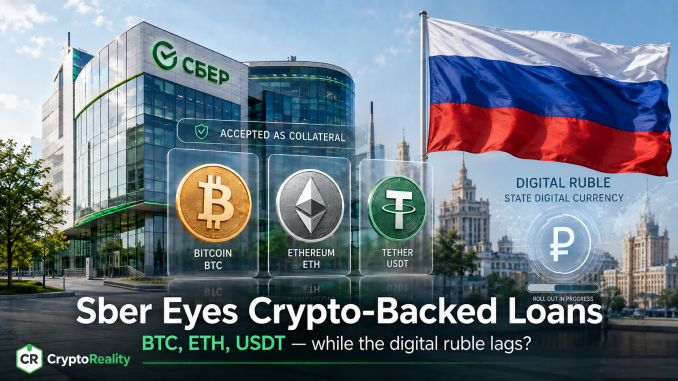
Russia is expanding its state-controlled digital currency. At the same time, its largest bank wants to lend against Bitcoin, Ethereum and USDT — and openly questions whether customers even want the digital ruble. The contradiction makes more sense when you follow the money.
Russia is taking one of its biggest steps yet toward a state-controlled digital currency.
From September 1, 2026, the country’s largest banks must begin giving customers access to the digital ruble, while large retailers will also start falling under requirements to accept it.
At almost exactly the same time, Russia’s largest bank is moving in a different direction.
Sber wants to expand lending backed by Bitcoin, Ethereum and Tether’s USDT.
More surprisingly, Sber’s own chief financial officer has publicly questioned whether Russians actually want the digital ruble at all.
At first glance, that looks contradictory.
Why would a state-controlled Russian bank prepare to work with Bitcoin, Ethereum and a dollar-linked stablecoin while the Russian state is simultaneously expanding its own digital currency?
The answer may have less to do with ideology than with something much simpler:
where the money sits, who controls it and who gets to earn from it.
The digital ruble is moving into the mainstream banking system
The digital ruble is not a cryptocurrency like Bitcoin.
It is a central bank digital currency, or CBDC, issued and operated by the Bank of Russia.
Under the current rollout schedule, major Russian banks must begin providing customers with digital-ruble services from September 1, 2026. Large merchants connected to those banks will also begin facing requirements to accept digital-ruble payments.
For individuals, however, use remains voluntary.
The Bank of Russia says people will not automatically receive digital-ruble accounts and can decide for themselves whether they want to use the system.
Bank of Russia — digital ruble rollout
There is another important difference between a digital ruble and money sitting in a normal bank account.
Digital rubles are held on the Bank of Russia’s platform. Commercial banks provide the customer interface, but the underlying digital currency exists inside the central bank’s infrastructure.
The Bank of Russia also says digital rubles will not pay interest, and the central bank will not use them to make loans directly to customers.
Bank of Russia — digital ruble FAQ
That detail becomes important when we look at Sber.
Sber wants to lend against crypto
Sber is preparing to expand lending backed by cryptocurrency.
Deputy Chairman Anatoly Popov has said the bank plans to support Bitcoin, Ether and USDT as collateral as Russia develops its regulated crypto market.
Ether and USDT would be added when the relevant regulatory framework allows them.
Cointelegraph — Sber crypto-backed lending plans
This does not mean Sber wants Bitcoin to replace the ruble.
It does not mean Russians will suddenly be paying for groceries in Bitcoin through Sber.
The proposal is much more conventional.
A customer owns crypto. Instead of selling it, the customer pledges it as collateral and borrows conventional money from the bank.
From Sber’s perspective, Bitcoin does not need to become money.
It only needs to be valuable enough to lend against.
That is a very different proposition.
Then Sber questioned demand for the digital ruble
This is where the story becomes more interesting.
Sber CFO Taras Skvortsov has said the bank does not currently see strong mass demand for the digital ruble.
According to Interfax, Skvortsov said there was little visible interest among ordinary customers, businesses or financial institutions outside the central bank itself.
Sber reportedly expects digital-ruble transactions to represent only tenths of a percent of total turnover at first.
Interfax — Sber on digital ruble demand
But another part of his comments is even more important.
Money converted into digital rubles no longer sits inside the commercial banking system in quite the same way.
The customer may still reach the money through Sber’s app or interface, but the underlying digital rubles are held on the Bank of Russia platform.
For a commercial bank, that matters.
A normal bank deposit is useful.
It helps fund lending and other financial activity.
A digital ruble held on the central-bank platform is different.
That may explain why Sber’s view sounds so unusual.
Follow the deposits
Imagine a customer has one million rubles sitting in a normal Sber account.
That money forms part of Sber’s deposit base.
The bank can use deposits as part of the broader machinery that supports lending and generates income.
Now imagine that the customer moves a large part of those funds into digital rubles.
The customer still owns the same nominal amount of money, but from Sber’s perspective the relationship has changed.
The funds are now sitting inside the central-bank digital-ruble system rather than simply remaining as a conventional commercial-bank deposit.
Now compare that with crypto-backed lending.
A customer owns Bitcoin.
Instead of selling it, the customer pledges it to Sber and borrows rubles.
Sber potentially gets a borrower, interest income, collateral and a deeper banking relationship.
The two products therefore pull in almost opposite directions.
The digital ruble can move money toward the central bank’s platform.
Crypto collateral can pull outside assets into a commercial-bank relationship.
Seen that way, Sber’s position becomes much easier to understand.
This may not be a fight between crypto and a CBDC.
It may be a fight over where financial activity happens.
Sber is not an ordinary private bank
There is another reason this story is unusual.
Sber is not a fully independent private bank standing in opposition to the Russian government.
The Russian state, through the Ministry of Finance, controls 50% plus one voting share of Sber.
Bank of Russia — state acquisition of controlling Sber stake
So this is not simply a private bank resisting government policy.
Instead, we are watching different parts of the same financial system respond to different incentives.
The Bank of Russia is building a sovereign digital currency.
Russia’s largest state-controlled commercial bank is preparing to lend against Bitcoin, Ethereum and USDT while questioning how much customers actually want that sovereign digital currency.
That is far more interesting than saying Russia has suddenly “embraced crypto.”
Institutions can belong to the same political system and still want very different economic outcomes.
USDT may be the strangest part of the story
Bitcoin naturally attracts most of the attention.
Ethereum gives Sber another major crypto asset to use as collateral.
But USDT may be the most revealing asset on the list.
USDT is designed to track the U.S. dollar.
That means Russia’s largest bank is considering a privately issued, dollar-linked digital asset as acceptable collateral while Russia is simultaneously expanding its own sovereign digital currency.
This does not mean Russia is adopting USDT as money.
It does not mean Sber can do anything it wants with stablecoins without regulatory approval.
But the combination is still remarkable.
Inside the same emerging Russian digital-finance system, we could eventually have:
a Russian central-bank digital currency, Bitcoin, Ethereum and a privately issued dollar-linked stablecoin.
Rather than one form of digital money replacing all the others, several different financial layers may simply coexist.
CBDCs may not replace crypto
For years, CBDCs have often been described as a possible government answer to cryptocurrency.
The assumption was simple: once central banks created official digital money, private crypto assets might become less important.
Russia suggests the situation could be more complicated.
The assets do different things.
Bitcoin can function as a scarce asset and collateral.
Ethereum can support programmable financial infrastructure.
USDT provides dollar-linked liquidity.
The digital ruble gives the Russian state its own sovereign digital payment rail.
Those functions overlap, but they are not identical.
A commercial bank may therefore have little reason to choose only one.
It may be more profitable to build services around all of them.
The real competition may be over control
There is no evidence that Sber’s crypto strategy is a rebellion against the Bank of Russia.
There is also no evidence that Russia intends Bitcoin, Ethereum or USDT to replace the ruble.
And Sber’s comments do not prove the digital ruble has failed before the broader rollout has properly begun.
But the incentives create a much larger question.
If people eventually have meaningful access to three different kinds of money —
commercial-bank money, central-bank digital money and privately issued or decentralized digital assets —
then the competition may not simply be about which currency is worth more.
The important questions become:
Who holds the money?
Who controls the payment infrastructure?
Who earns interest and fees?
Who owns the customer relationship?
Who can see the transactions?
And who remains necessary in the middle?
That is why Russia’s experiment matters beyond Russia.
Commercial banks elsewhere could eventually face exactly the same problem.
A central bank can create digital money.
Governments can regulate it.
They can require banks to support it.
But they cannot automatically make customers want to use it.
That may be the most important part
Russia does not appear to be choosing between crypto and a CBDC.
At least not yet.
Instead, it is building a financial system where central-bank money, commercial banks and crypto assets may all operate beside one another.
Sber’s behavior gives us a clue about what happens next.
Banks will support whatever regulation requires them to support.
But they will also look for products that protect their role, bring assets into the banking system and generate revenue.
For Sber, Bitcoin, Ethereum and USDT may offer something the digital ruble does not:
a reason for customers to borrow from the bank.
And that brings us back to the contradiction.
Russia’s central bank wants people to use a new form of sovereign digital money.
Russia’s biggest commercial bank is asking whether those people actually want it.
At the same time, the bank is looking for ways to make money from crypto.
That is not necessarily hypocrisy.
It may simply be economics.
Because the most important battle in digital finance may not be over which currency wins.
It may be over who still gets to stand between the money and the customer.
Sources
Bank of Russia — Digital ruble rollout
https://www.cbr.ru/eng/press/event/?id=32808
Bank of Russia — Digital ruble FAQ
https://cbr.ru/faq/dr/
Bank of Russia — Digital ruble implementation requirements
https://www.cbr.ru/rbr/dir_decisions/rsd_2026-08-28_45_02
Interfax — Sber CFO Taras Skvortsov on digital ruble demand
https://www.interfax.ru/amp/1094226
Cointelegraph — Sber plans BTC, ETH and USDT-backed loans
https://cointelegraph.com/news/russia-sber-bank-bitcoin-ether-usdt-crypto-loans
Bank of Russia — Russian state acquisition of controlling Sber stake
https://www.cbr.ru/eng/press/pr/?file=10042020_141349eng2020-04-10t14_13_19.htm
CryptoReality publishes independent analysis for information only. Nothing on this site is investment advice. Crypto assets are highly volatile and you can lose all of the money you invest.


